
J
John Iwuozor
Guest
LLMO enables AI systems to interpret and describe your brand when users ask questions in your space. Here’s how it fits in with GEO and AEO for your content strategy.
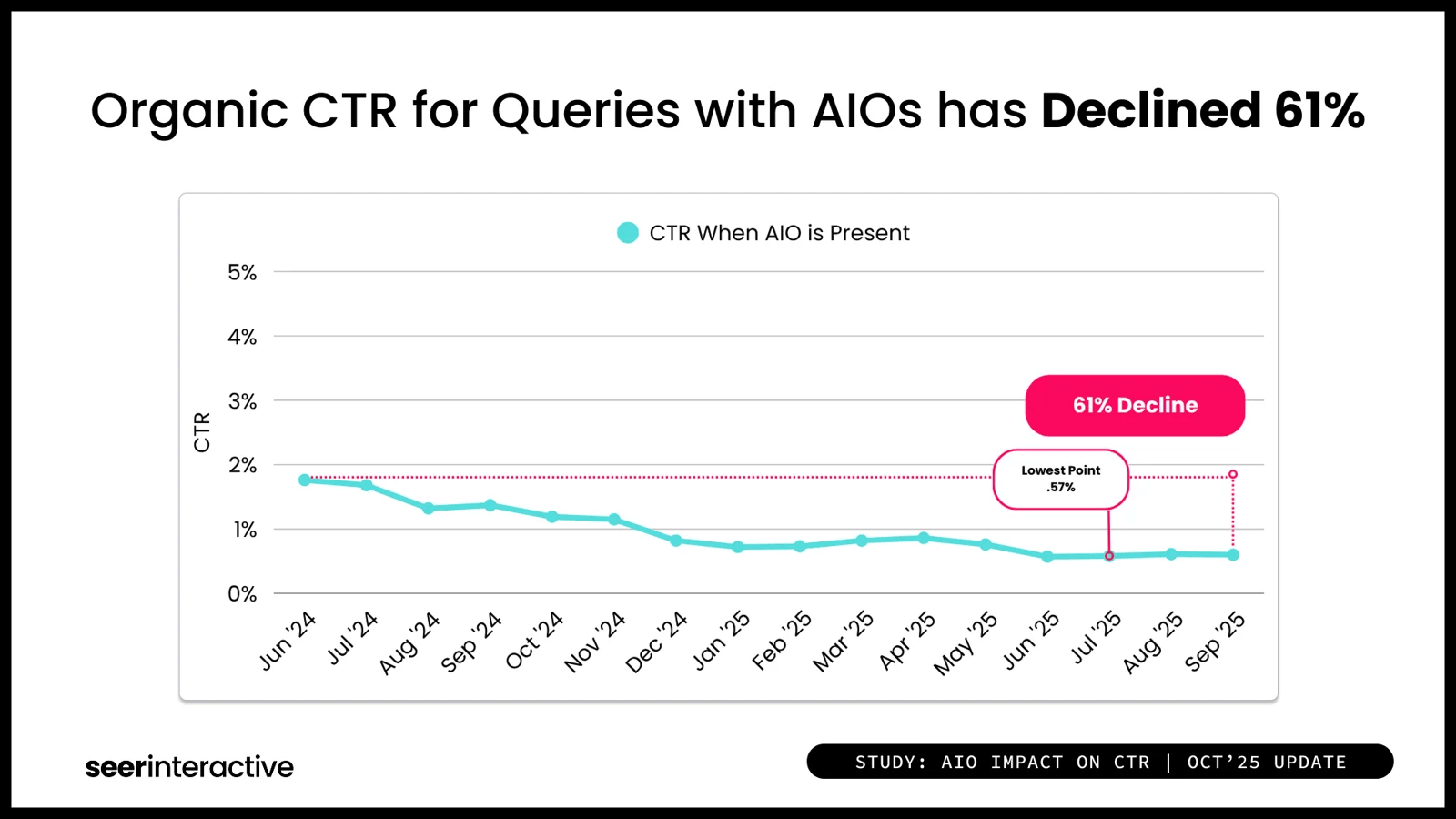
Organic traffic is declining. Seer Interactive’s study of 3,119 informational queries across 42 organizations found that organic click-through rates (CTR) dropped 61% between June 2024 and September 2025 on queries where AI Overviews appear.
Source: Seer Interactive
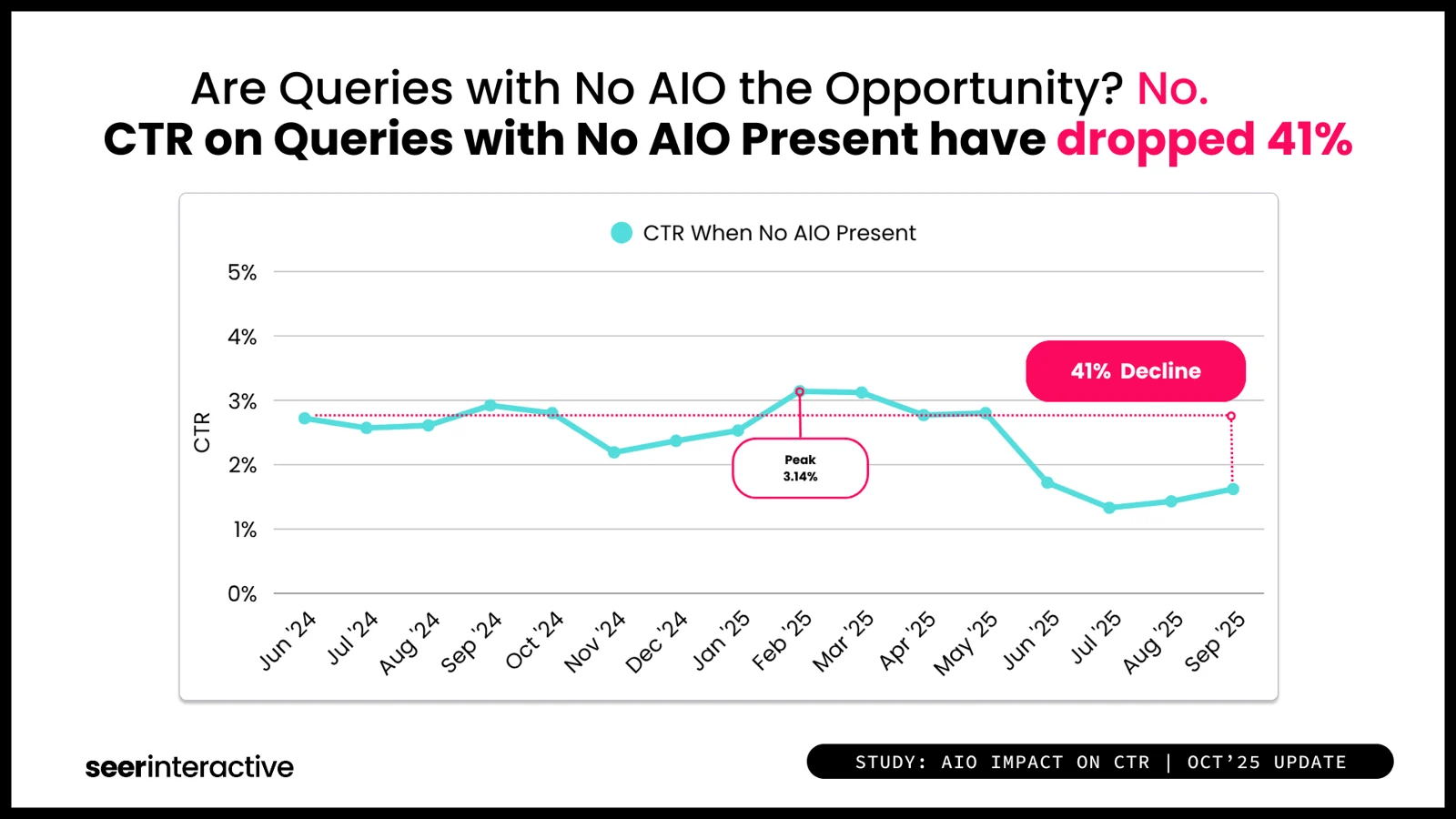
On queries where AI Overviews do not appear, CTR still fell 41%.
Source: Seer Interactive
What does this mean? Search is becoming a zero-click environment, where readers are increasingly getting answers without ever visiting a website.
Those answers come from generative experiences/LLMs like AI Overviews, AI Mode, ChatGPT, Perplexity and the like. These platforms reduce the cognitive load of research by synthesizing information and delivering a direct response.
In fact, one study shows that visitors arriving from these platforms convert at 4.4 times the rate of traditional organic visitors. When users are increasingly faced with the “paradox of choice,” they tend to follow the recommendation of a system that has already done the research and compared the available options.
And that is precisely what makes them so significant both for the average consumer and the biggest B2B brand. Decisions are made based on what machine learning models trained on datasets say and recommend.
That recommendation, from what it says about your brand, how accurately it describes you, to whether you appear at all, is what LLMO is about.
LLMO stands for Large Language Model Optimization. It’s the practice of making sure AI systems can accurately understand, interpret and describe your brand when users ask questions in your space.
It overlaps considerably with GEO (Generative Engine Optimization) and AEO (Answer Engine Optimization), and the terms are sometimes used interchangeably.
There are, however, minor nuances that make each worth its own definition, even though they are all describing different layers of the same problem. The earlier piece on AEO, GEO & SEO covers these distinctions in detail.
This cheat sheet breaks down where each one sits.
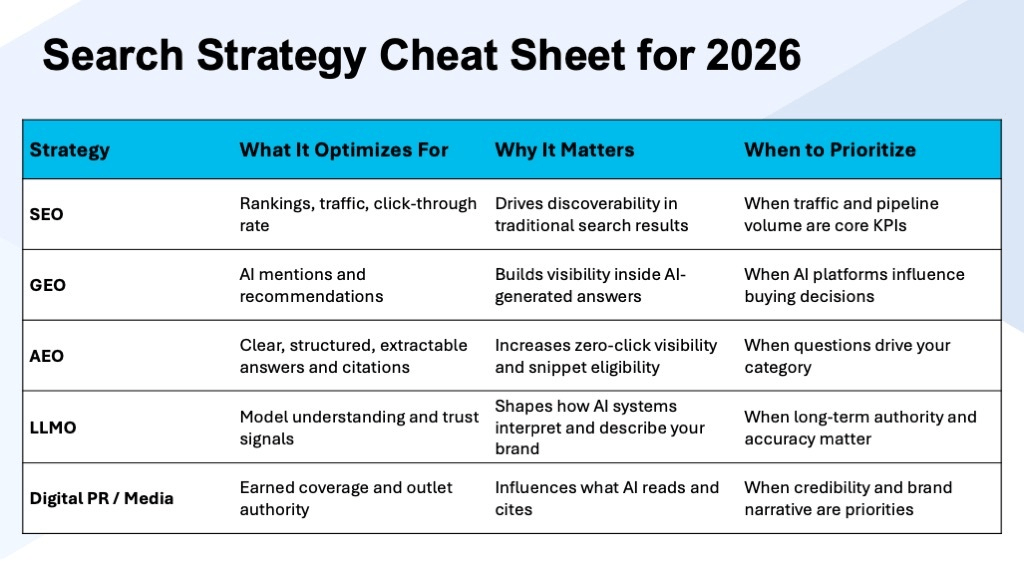
LLMO’s specific focus is on model understanding and trust signals. It asks whether the model has a clear, accurate and consistent enough picture of your brand to cite you confidently in the first place.
That’s because a brand can do everything right on the content side and still be misrepresented or absent in AI answers if the broader signal across the web is thin, inconsistent or contradictory.
To understand what LLMO actually requires, it helps to understand how LLMs build their picture of a brand in the first place.
These systems do not learn about your company from your website alone. They absorb text from everywhere: your pages, reviews on G2 and Trustpilot, Reddit discussions, journalist coverage, analyst reports, press releases, community forums, LinkedIn posts and anything else they encounter at scale.
From all of that, they build some sort of entity model, which describes a semantic representation of what your brand is, what category it belongs to, what problems it solves and how credible it seems as a source.
A survey by McKinsey found that a brand’s own website accounts for only 5 to 10% of the sources AI search platforms reference. The other 90 to 95% comes from publishers, user-generated content, affiliate sites and review platforms.
This makes LLMO as much a brand governance and earned media problem as it is a content problem. As even companies with good content and strong organic rankings can still be invisible or misrepresented in AI-generated answers.
So what does building that understanding actually require? It comes down to a few key areas.
As mentioned, AI systems build a picture of your brand from the aggregate of what they encounter, so consistency across third-party pages, review platforms, directory listings and earned media matters as much as your own content.
If your website describes your product one way, your G2 profile says something different and a journalist described you in a third way entirely, the model has no single confident answer to what you actually are. The output it produces will reflect that uncertainty.
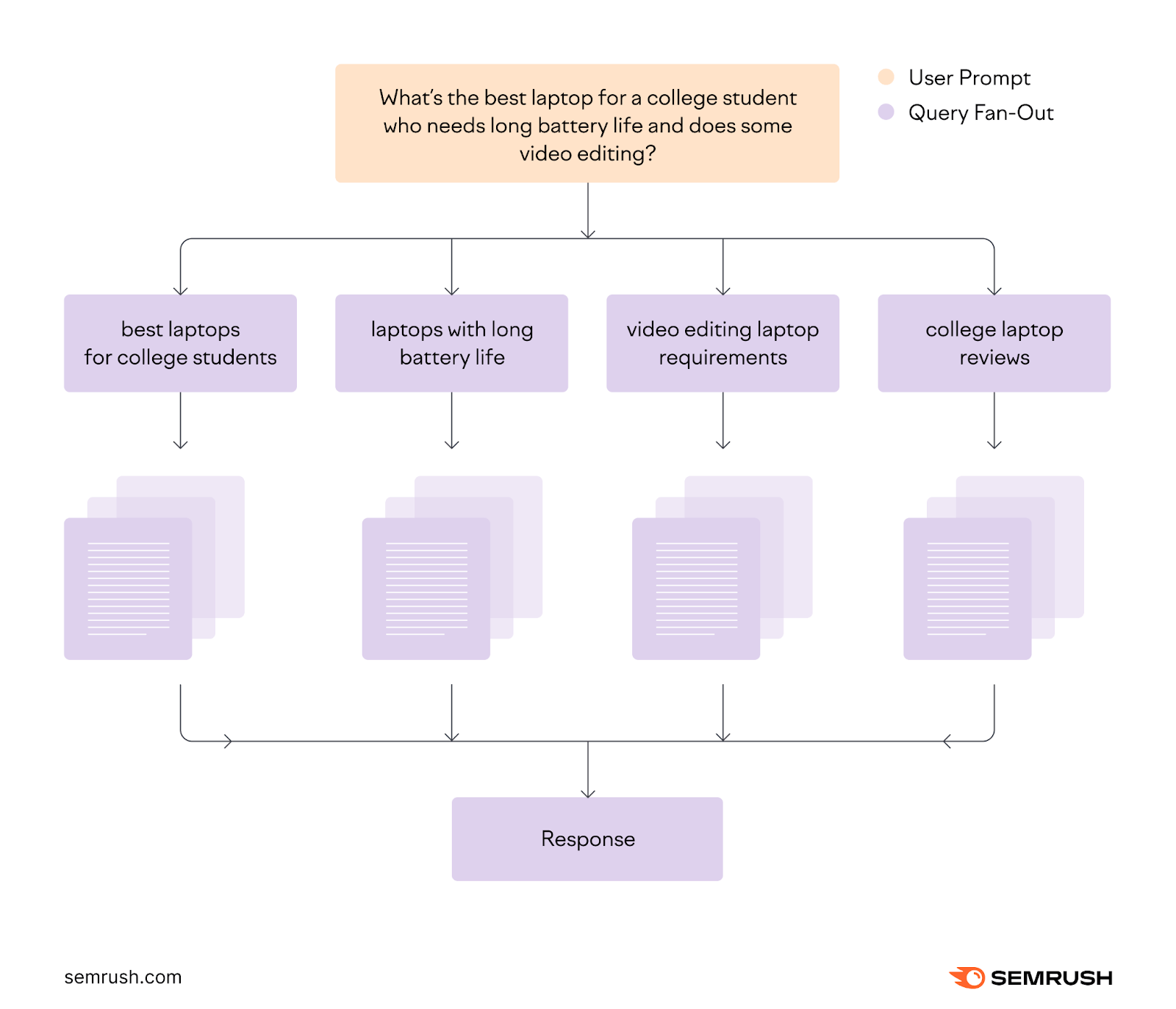
When a user types a query into an AI system, the system does not just look for one answer. It breaks that query into a series of sub-queries, a process called query fan-out, and pulls from whichever sources best answer each one.
Source: Semrush
This concept has been gaining significant attention in the SEO community, and for good reason. Surfer SEO’s analysis of 10,000 keywords found that pages ranking for fan-out queries are 161% more likely to be cited in AI Overviews than pages ranking only for the main query.
The implication here is that brands that publish interconnected, comprehensive content across a topic are structurally better positioned than those with isolated strong pages.
The goal of LLMs is to answer questions, and to do that well, they need sources they can actually point to. That means the content that gets cited is one that takes a clear position, backs it with something specific, and gives the model a named source to attribute it to.
Proprietary data, named author expertise, case studies with real numbers, and genuine point-of-view content all do that. The more attributable and specific your content is, the stronger your signal becomes relative to everything else the model has encountered on the same topic.
The same Seer data found that brands cited in AI Overviews earn 35% more organic clicks and 91% more paid clicks compared to those not cited at all. Being the source an AI quotes creates a halo effect across every other channel.
That is what makes digital PR and earned media so consequential in this context. Coverage in credible publications, third-party mentions and authoritative external references are among the primary signals AI systems use to assess whether a brand is worth recommending.
It’s worth noting that the responsibility for AI search optimization does not sit in one place in an organization. SEO, GEO, AEO and LLMO all require a combination of content decisions, technical infrastructure and shared governance that no single team can own end to end.
For example, on the marketing side, the work centers on mapping content to search intent cluster, building trust signals through author credibility and original insight, and maintaining consistent brand voice and clear value communication across every channel where your brand appears.
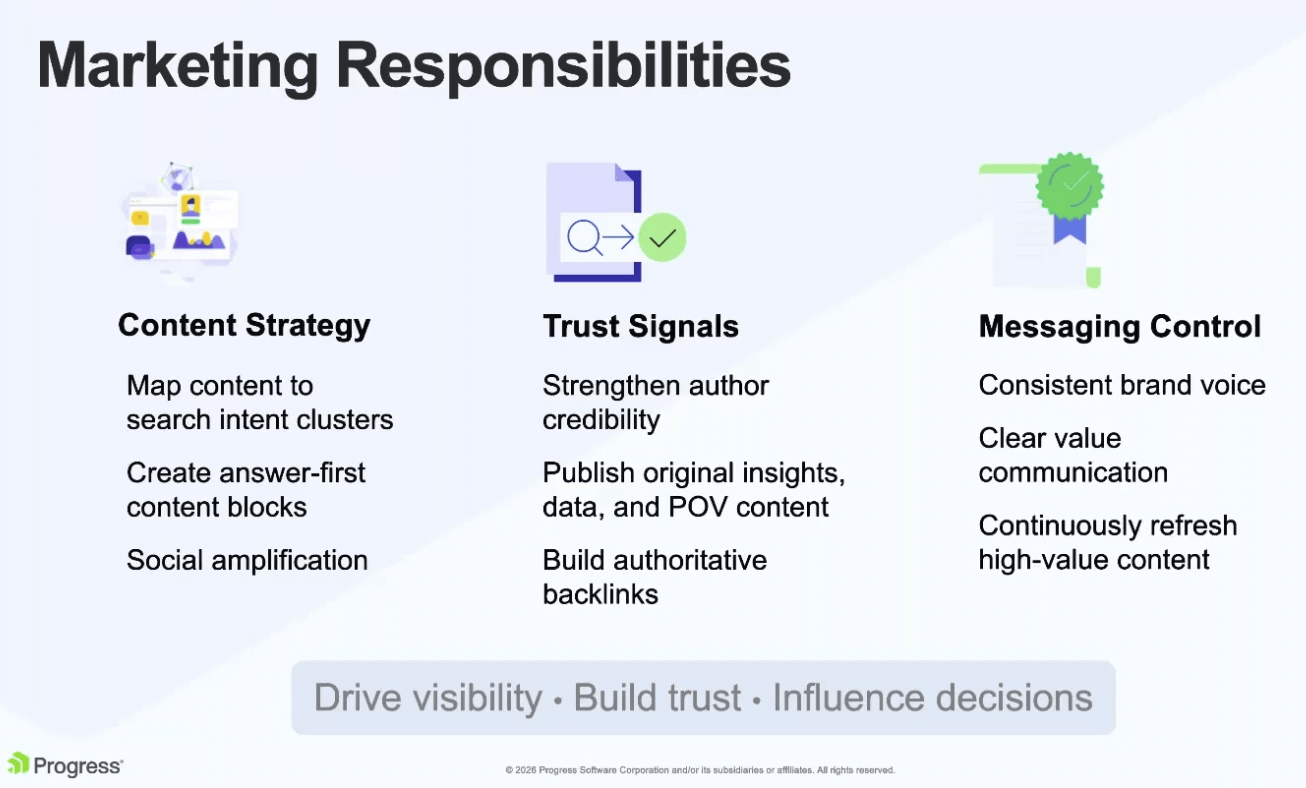
These are the inputs that shape how AI systems learn to describe and recommend you (the point of LLMO).
On the IT side, it’s about making sure the technical foundation can support what marketing is trying to do.
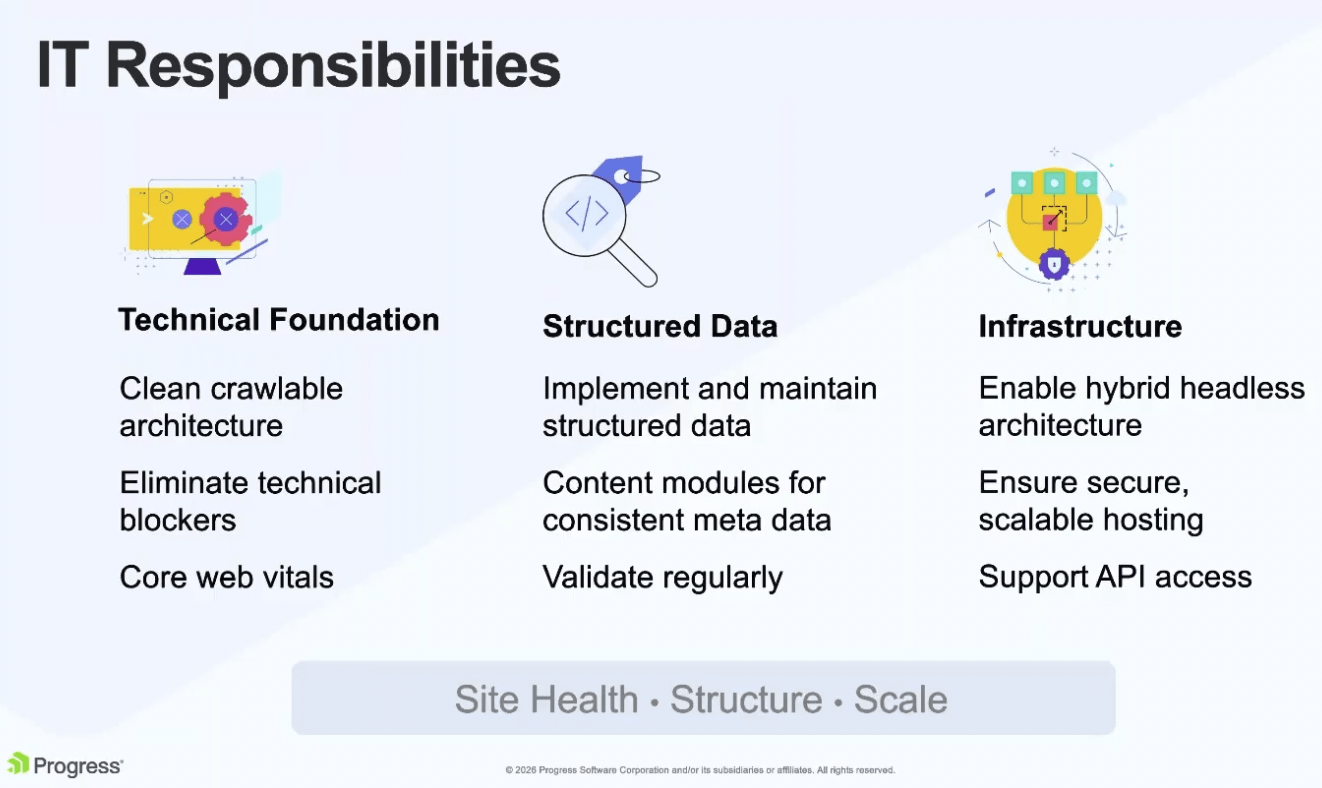
If AI crawlers cannot access your content, or if schema markup is missing or incorrect, the model is working with an incomplete picture regardless of how well the content itself is written.
The signals AI systems use to understand a brand do not stay still. As the systems themselves get more capable, the standard for what counts as a usable, citable signal keeps rising.
Most of the AI search conversation so far has focused on retrieval: getting your content in front of the model so it can cite you. Make sure it’s crawlable, structure it cleanly, add the right schema, and the model will pull from it when it needs to. That framing is still correct. It just stops being the whole picture once the systems doing the retrieving start reasoning across what they pull.
Traditional retrieval-augmented generation (RAG) works in a single shot. The system takes a query, searches a knowledge base, pulls the most relevant passages, feeds them to the LLM and generates a response.
Agentic RAG works differently. The agent retrieves, reads what it got, decides whether that’s enough to answer the question and retrieves again from a different angle or source if it’s not. This iterative loop, planning, retrieving, checking and refining, is a defining feature of agentic retrieval systems.
That changes what content has to do. In a single-retrieval setup, inconsistencies across pages often go unnoticed because only one source is used. In a multi-step system, where multiple sources are retrieved and evaluated in sequence, those inconsistencies are more likely to surface. Errors can compound across steps, and conflicting signals can degrade the quality of the final answer or reduce confidence in the sources being used.
This is true regardless of which agentic system is doing the reasoning. The constraint sits in the architecture, not in any one product.
Brand voice inconsistencies, missing or incorrect schema, unstructured metadata and poorly classified content all become more expensive under this model because the cost of leaving them in place compounds across every retrieval the agent performs.
That is also why the fix is more useful at the point of publishing than in a retrospective audit. Once these issues are spread across a content library, finding and resolving them retroactively becomes its own project.
This is what CMS platforms are now responding to, and Progress Sitefinity CMS is one of the more forward examples. Sitefinity 15.4 builds the tooling for this directly into the publishing workflow rather than treating it as a retrospective audit:
That operational logic matters because the gap between knowing what LLMO requires and actually executing it consistently across a distributed content team is where most organizations get stuck. The tools that make consistency the default rather than a manual intervention are the ones that produce durable results.
LLMO does not replace the fundamentals of good content strategy. It only attempts to answer the question many brands are asking: “if AI is now the first point of contact between a user and a recommendation, what does that recommendation say about us?”
This makes the underlying problems more visible, because AI systems amplify what they find, whether that is clarity and authority or confusion and vagueness.
The brands building lasting visibility in AI search are investing in being the most understandable, credible, and consistent entity in their category across every surface where they appear, not just the ones they own.
For a practical framework covering what this looks like in execution across SEO, GEO, AEO and LLMO together, the Progress on-demand webinar Strategizing for SEO and GEO Success in 2026 and Beyond covers a fuller picture. And host Zach Stone wrote a follow-up piece with even more insight: A Practical Guide for SEO and GEO in 2026.
Continue reading...
Organic traffic is declining. Seer Interactive’s study of 3,119 informational queries across 42 organizations found that organic click-through rates (CTR) dropped 61% between June 2024 and September 2025 on queries where AI Overviews appear.
Source: Seer Interactive
On queries where AI Overviews do not appear, CTR still fell 41%.
Source: Seer Interactive
What does this mean? Search is becoming a zero-click environment, where readers are increasingly getting answers without ever visiting a website.
Those answers come from generative experiences/LLMs like AI Overviews, AI Mode, ChatGPT, Perplexity and the like. These platforms reduce the cognitive load of research by synthesizing information and delivering a direct response.
In fact, one study shows that visitors arriving from these platforms convert at 4.4 times the rate of traditional organic visitors. When users are increasingly faced with the “paradox of choice,” they tend to follow the recommendation of a system that has already done the research and compared the available options.
And that is precisely what makes them so significant both for the average consumer and the biggest B2B brand. Decisions are made based on what machine learning models trained on datasets say and recommend.
That recommendation, from what it says about your brand, how accurately it describes you, to whether you appear at all, is what LLMO is about.
What Is LLMO and How Does It Fit the Broader Picture?
LLMO stands for Large Language Model Optimization. It’s the practice of making sure AI systems can accurately understand, interpret and describe your brand when users ask questions in your space.
It overlaps considerably with GEO (Generative Engine Optimization) and AEO (Answer Engine Optimization), and the terms are sometimes used interchangeably.
There are, however, minor nuances that make each worth its own definition, even though they are all describing different layers of the same problem. The earlier piece on AEO, GEO & SEO covers these distinctions in detail.
This cheat sheet breaks down where each one sits.
LLMO’s specific focus is on model understanding and trust signals. It asks whether the model has a clear, accurate and consistent enough picture of your brand to cite you confidently in the first place.
That’s because a brand can do everything right on the content side and still be misrepresented or absent in AI answers if the broader signal across the web is thin, inconsistent or contradictory.
How LLMs Build Their Understanding of Your Brand
To understand what LLMO actually requires, it helps to understand how LLMs build their picture of a brand in the first place.
These systems do not learn about your company from your website alone. They absorb text from everywhere: your pages, reviews on G2 and Trustpilot, Reddit discussions, journalist coverage, analyst reports, press releases, community forums, LinkedIn posts and anything else they encounter at scale.
From all of that, they build some sort of entity model, which describes a semantic representation of what your brand is, what category it belongs to, what problems it solves and how credible it seems as a source.
A survey by McKinsey found that a brand’s own website accounts for only 5 to 10% of the sources AI search platforms reference. The other 90 to 95% comes from publishers, user-generated content, affiliate sites and review platforms.
This makes LLMO as much a brand governance and earned media problem as it is a content problem. As even companies with good content and strong organic rankings can still be invisible or misrepresented in AI-generated answers.
So what does building that understanding actually require? It comes down to a few key areas.
Entity Consistency Across the Web
As mentioned, AI systems build a picture of your brand from the aggregate of what they encounter, so consistency across third-party pages, review platforms, directory listings and earned media matters as much as your own content.
If your website describes your product one way, your G2 profile says something different and a journalist described you in a third way entirely, the model has no single confident answer to what you actually are. The output it produces will reflect that uncertainty.
Topical Depth Over Breadth
When a user types a query into an AI system, the system does not just look for one answer. It breaks that query into a series of sub-queries, a process called query fan-out, and pulls from whichever sources best answer each one.
Source: Semrush
This concept has been gaining significant attention in the SEO community, and for good reason. Surfer SEO’s analysis of 10,000 keywords found that pages ranking for fan-out queries are 161% more likely to be cited in AI Overviews than pages ranking only for the main query.
The implication here is that brands that publish interconnected, comprehensive content across a topic are structurally better positioned than those with isolated strong pages.
Original Insight Models Can Attribute to You
The goal of LLMs is to answer questions, and to do that well, they need sources they can actually point to. That means the content that gets cited is one that takes a clear position, backs it with something specific, and gives the model a named source to attribute it to.
Proprietary data, named author expertise, case studies with real numbers, and genuine point-of-view content all do that. The more attributable and specific your content is, the stronger your signal becomes relative to everything else the model has encountered on the same topic.
Earned Media as an AI Visibility Strategy
The same Seer data found that brands cited in AI Overviews earn 35% more organic clicks and 91% more paid clicks compared to those not cited at all. Being the source an AI quotes creates a halo effect across every other channel.
That is what makes digital PR and earned media so consequential in this context. Coverage in credible publications, third-party mentions and authoritative external references are among the primary signals AI systems use to assess whether a brand is worth recommending.
Optimizing for AI Search Is Not a One-Team Problem
It’s worth noting that the responsibility for AI search optimization does not sit in one place in an organization. SEO, GEO, AEO and LLMO all require a combination of content decisions, technical infrastructure and shared governance that no single team can own end to end.
For example, on the marketing side, the work centers on mapping content to search intent cluster, building trust signals through author credibility and original insight, and maintaining consistent brand voice and clear value communication across every channel where your brand appears.
These are the inputs that shape how AI systems learn to describe and recommend you (the point of LLMO).
On the IT side, it’s about making sure the technical foundation can support what marketing is trying to do.
If AI crawlers cannot access your content, or if schema markup is missing or incorrect, the model is working with an incomplete picture regardless of how well the content itself is written.
Agentic AI Is Raising the Bar for Content Infrastructure
The signals AI systems use to understand a brand do not stay still. As the systems themselves get more capable, the standard for what counts as a usable, citable signal keeps rising.
Most of the AI search conversation so far has focused on retrieval: getting your content in front of the model so it can cite you. Make sure it’s crawlable, structure it cleanly, add the right schema, and the model will pull from it when it needs to. That framing is still correct. It just stops being the whole picture once the systems doing the retrieving start reasoning across what they pull.
Traditional retrieval-augmented generation (RAG) works in a single shot. The system takes a query, searches a knowledge base, pulls the most relevant passages, feeds them to the LLM and generates a response.
Agentic RAG works differently. The agent retrieves, reads what it got, decides whether that’s enough to answer the question and retrieves again from a different angle or source if it’s not. This iterative loop, planning, retrieving, checking and refining, is a defining feature of agentic retrieval systems.
That changes what content has to do. In a single-retrieval setup, inconsistencies across pages often go unnoticed because only one source is used. In a multi-step system, where multiple sources are retrieved and evaluated in sequence, those inconsistencies are more likely to surface. Errors can compound across steps, and conflicting signals can degrade the quality of the final answer or reduce confidence in the sources being used.
This is true regardless of which agentic system is doing the reasoning. The constraint sits in the architecture, not in any one product.
Brand voice inconsistencies, missing or incorrect schema, unstructured metadata and poorly classified content all become more expensive under this model because the cost of leaving them in place compounds across every retrieval the agent performs.
That is also why the fix is more useful at the point of publishing than in a retrospective audit. Once these issues are spread across a content library, finding and resolving them retroactively becomes its own project.
This is what CMS platforms are now responding to, and Progress Sitefinity CMS is one of the more forward examples. Sitefinity 15.4 builds the tooling for this directly into the publishing workflow rather than treating it as a retrospective audit:
- Automatic Schema.org JSON-LD structured data generated using existing fields, taxonomies and relationships, giving search engines and AI systems the context they need to interpret content without manual configuration on every page.
- The Brand Agent, an AI assistant inside the editor that reviews content as it’s being written and suggests adjustments aligned with brand guidelines, so tone and messaging stay consistent across regions, authors and departments.
- The SEO Agent, which provides metadata recommendations (titles, meta descriptions, alt text, canonical URLs) directly inside the editor, aligned to how people actually search across both traditional and AI discovery surfaces.
- The Sitefinity × PARAG Connector, which continuously syncs content, media and metadata with Progress Agentic RAG for indexing and retrieval, so AI-generated answers stay grounded in current, approved CMS content rather than whatever the model happens to surface.
That operational logic matters because the gap between knowing what LLMO requires and actually executing it consistently across a distributed content team is where most organizations get stuck. The tools that make consistency the default rather than a manual intervention are the ones that produce durable results.
Wrapping Up
LLMO does not replace the fundamentals of good content strategy. It only attempts to answer the question many brands are asking: “if AI is now the first point of contact between a user and a recommendation, what does that recommendation say about us?”
This makes the underlying problems more visible, because AI systems amplify what they find, whether that is clarity and authority or confusion and vagueness.
The brands building lasting visibility in AI search are investing in being the most understandable, credible, and consistent entity in their category across every surface where they appear, not just the ones they own.
For a practical framework covering what this looks like in execution across SEO, GEO, AEO and LLMO together, the Progress on-demand webinar Strategizing for SEO and GEO Success in 2026 and Beyond covers a fuller picture. And host Zach Stone wrote a follow-up piece with even more insight: A Practical Guide for SEO and GEO in 2026.
Continue reading...