
J
John Iwuozor
Guest
Learn how your CMS impacts AI search visibility and how structured data, taxonomy, metadata and content governance can improve discoverability.
Most marketing teams optimizing for AI search are focused on the right things: content depth, structured data, topical authority and citation-worthy research.
However, far fewer are examining the system underneath all of that content: the CMS itself.
Yes, your CMS can affect AI search visibility. CMS architecture influences how consistently search and AI systems can interpret your content through canonicalization, metadata, structured data, taxonomy and internal linking. An AI-ready CMS helps make these signals consistent across your site, reducing ambiguity for systems retrieving and interpreting your content.
The working assumption is that a CMS is a neutral vessel. Content goes in, pages come out and visibility depends mainly on what you publish and how well you optimize it. But that’s not the full picture.
As AI systems grow more sophisticated in how they retrieve, interpret and cite content, the architecture of your CMS is increasingly a factor in whether your content gets surfaced or overlooked.
Gartner projects that traditional search engine volume will drop 25% by 2026, with organic search traffic falling 50% by 2028 as consumers shift to AI-powered search.
Understanding what AI search systems look for (and whether your CMS is structurally equipped to deliver it) is then a present-tense question, not a future-state consideration.
To understand why the CMS matters, it helps to look at how AI search systems find and interpret information.
Platforms like ChatGPT, Perplexity and Google AI Overviews do not evaluate pages in the same way as conventional search systems.
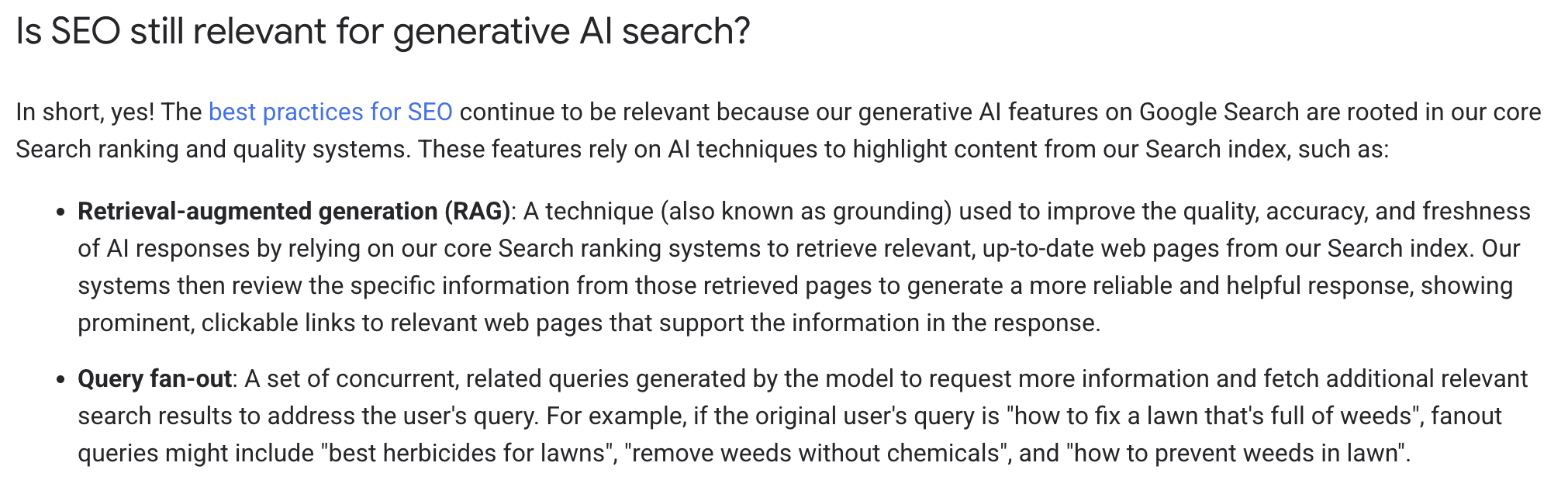
Instead, they use retrieval-based pipelines that follow the broad pattern of retrieval-augmented generation (RAG). This means relevant pages and passages are retrieved from external sources and supplied to the model as context before it generates an answer.
These LLMs may also use query fan-out, issuing several related searches to find supporting pages for different parts of a question.
Source: Google
In both cases, the system must first identify which pages are relevant, what each passage means and which version of the information it should trust.
That is why a well-written page can still be difficult to discover or interpret, especially if the surrounding website architecture sends weak or conflicting signals.
Other common problems include:
The content may be strong, but if the signals AI systems rely on to interpret and cite it are absent, inconsistent or scattered, that strength will not translate into visibility.
There is evidence that AI visibility and traditional search do not always follow the same pattern. A 5W report found that the overlap between top-ranking Google pages and sources cited in AI-generated answers had fallen from around 70% to under 20%.
The finding does not mean traditional SEO has stopped mattering. It does suggest that ranking well for a query does not automatically guarantee that the same page will be selected as a source by an AI system.
There are several ways a CMS can undermine AI search visibility that have nothing to do with content quality:
CMS platforms frequently generate multiple URLs for the same content, that is, paginated versions of the same page, category and tag archives that repeat article summaries, or content served at both www and non-www addresses.
When AI systems encounter multiple pages covering the same topic, they struggle to determine which version carries the authoritative signal. Microsoft’s guidance on AI search identifies this as one of the primary ways duplicate content fragments intent signals and reduces the likelihood that any version gets cited.
Metadata covers page titles, descriptions, alt text, canonical URLs and Open Graph tags. It gives AI systems machine-readable context about what a page is and who it is for. In many CMS environments, these fields are entered manually and applied inconsistently. Which means titles are duplicated, descriptions skipped and canonical tags configured incorrectly or omitted altogether. The result is a site where AI systems have to guess at context rather than read it directly.
Taxonomy is the classification structure that groups content by topic, audience, intent and content type. It’s one of the primary mechanisms through which AI systems establish a site’s topical authority. A site where taxonomy is applied inconsistently across teams, or where no taxonomy exists at all, is a site where AI cannot reliably identify what the brand knows, what it covers or how its content relates to specific queries.
Organizations frequently run multiple content systems simultaneously: a blog on one platform, product documentation on another, resources gated behind a third. When content is scattered across disconnected repositories, AI systems cannot connect the dots to establish coherent topical authority. The brand appears fragmented, and no single source earns the depth of coverage that drives reliable citation.
AI systems depend on structured data, specifically Schema.org JSON-LD markup describing entities, relationships and content types, to interpret pages accurately. Without it, AI must infer context from raw HTML, which raises the likelihood of misinterpretation. A product page with no structured data is significantly more likely to be overlooked than a semantically identical page with that structure in place. While structured data is not a guarantee of citation or ranking, its absence forces every AI system that encounters your content to work harder and guess more.
The instinct when faced with these issues is to treat them as a content operations problem. In small, tightly managed content programs, that approach may work.
But in larger organizations with multiple sites, distributed authoring and high publication volume, it does not scale:
This creates a persistent gap between what editorial teams publish and the structured, consistent output that search and AI systems can interpret reliably.
The deeper issue is that many CMS platforms were not built to govern this complexity at scale. As organizations add generative search, personalization and conversational experiences to their digital presence, the same weaknesses in structure and governance become even more consequential.
As Loren Jarrett, EVP and GM of Digital Experience at Progress, explained at the launch of Sitefinity Generative CMS, many enterprises have experimented with generative AI without moving to large-scale use because of concerns around maturity and governability.
The shift requires a governed foundation that allows organizations to expand AI-powered experiences while maintaining control and brand consistency.
Fixing the structural issues that weaken AI visibility means addressing them at the platform level, rather than correcting every page individually after publication.
It starts with making structured data part of the publishing process. A CMS like Progress Sitefinity is able to generate Schema.org JSON-LD using existing content fields, taxonomies and relationships. For example, a product page can use existing fields such as the product name, price, availability, category and brand to generate machine-readable markup.
An AI-ready CMS also brings governance into the authoring workflow. The Sitefinity Brand Agent reviews content as it is written and suggests improvements based on the organization’s configured guidelines for tone, terminology, style and messaging. This helps distributed teams maintain a more consistent public-facing voice without relying on a separate review process to catch every variation.
Classification should also happen while content is being created, rather than during a large clean-up exercise months later. Sitefinity can analyze the text in a content item and suggest relevant tags, including tags that already exist within the project’s taxonomy. Editors still decide which suggestions to apply, but the feature makes consistent classification easier to maintain across a growing content estate.
Finally, optimization needs to sit inside the same workflow. The Sitefinity SEO Agent analyzes content and page-level signals and provides recommendations for areas such as titles, meta descriptions, alt text, canonical URLs, headings and semantic clarity. Instead of discovering these gaps after publication, teams can address them while the page is still being prepared.
While none of these capabilities guarantees that an AI system will retrieve or cite a page, together, they reduce the structural ambiguity that can prevent content from being interpreted and surfaced accurately.
Learn more about Sitefinity CMS today.
Request a Demo
Continue reading...
Most marketing teams optimizing for AI search are focused on the right things: content depth, structured data, topical authority and citation-worthy research.
However, far fewer are examining the system underneath all of that content: the CMS itself.
Yes, your CMS can affect AI search visibility. CMS architecture influences how consistently search and AI systems can interpret your content through canonicalization, metadata, structured data, taxonomy and internal linking. An AI-ready CMS helps make these signals consistent across your site, reducing ambiguity for systems retrieving and interpreting your content.
The working assumption is that a CMS is a neutral vessel. Content goes in, pages come out and visibility depends mainly on what you publish and how well you optimize it. But that’s not the full picture.
As AI systems grow more sophisticated in how they retrieve, interpret and cite content, the architecture of your CMS is increasingly a factor in whether your content gets surfaced or overlooked.
Gartner projects that traditional search engine volume will drop 25% by 2026, with organic search traffic falling 50% by 2028 as consumers shift to AI-powered search.
Understanding what AI search systems look for (and whether your CMS is structurally equipped to deliver it) is then a present-tense question, not a future-state consideration.
What AI Search Systems Actually Retrieve
To understand why the CMS matters, it helps to look at how AI search systems find and interpret information.
Platforms like ChatGPT, Perplexity and Google AI Overviews do not evaluate pages in the same way as conventional search systems.
Instead, they use retrieval-based pipelines that follow the broad pattern of retrieval-augmented generation (RAG). This means relevant pages and passages are retrieved from external sources and supplied to the model as context before it generates an answer.
These LLMs may also use query fan-out, issuing several related searches to find supporting pages for different parts of a question.
Source: Google
In both cases, the system must first identify which pages are relevant, what each passage means and which version of the information it should trust.
That is why a well-written page can still be difficult to discover or interpret, especially if the surrounding website architecture sends weak or conflicting signals.
Other common problems include:
- Duplicate pages competing to represent the same topic
- Metadata that does not accurately describe the visible content
- Structured data that is missing, incorrect or inconsistent
- Weak internal linking between related pages
- Inconsistent public-facing categories, tags and terminology
The content may be strong, but if the signals AI systems rely on to interpret and cite it are absent, inconsistent or scattered, that strength will not translate into visibility.
There is evidence that AI visibility and traditional search do not always follow the same pattern. A 5W report found that the overlap between top-ranking Google pages and sources cited in AI-generated answers had fallen from around 70% to under 20%.
The finding does not mean traditional SEO has stopped mattering. It does suggest that ranking well for a query does not automatically guarantee that the same page will be selected as a source by an AI system.
How Can a CMS Hurt AI Search Visibility?
There are several ways a CMS can undermine AI search visibility that have nothing to do with content quality:
Duplicate Content Across URLs
CMS platforms frequently generate multiple URLs for the same content, that is, paginated versions of the same page, category and tag archives that repeat article summaries, or content served at both www and non-www addresses.
When AI systems encounter multiple pages covering the same topic, they struggle to determine which version carries the authoritative signal. Microsoft’s guidance on AI search identifies this as one of the primary ways duplicate content fragments intent signals and reduces the likelihood that any version gets cited.
Inconsistent Metadata
Metadata covers page titles, descriptions, alt text, canonical URLs and Open Graph tags. It gives AI systems machine-readable context about what a page is and who it is for. In many CMS environments, these fields are entered manually and applied inconsistently. Which means titles are duplicated, descriptions skipped and canonical tags configured incorrectly or omitted altogether. The result is a site where AI systems have to guess at context rather than read it directly.
Weak or Inconsistent Taxonomy
Taxonomy is the classification structure that groups content by topic, audience, intent and content type. It’s one of the primary mechanisms through which AI systems establish a site’s topical authority. A site where taxonomy is applied inconsistently across teams, or where no taxonomy exists at all, is a site where AI cannot reliably identify what the brand knows, what it covers or how its content relates to specific queries.
Content Silos and Fragmented Governance
Organizations frequently run multiple content systems simultaneously: a blog on one platform, product documentation on another, resources gated behind a third. When content is scattered across disconnected repositories, AI systems cannot connect the dots to establish coherent topical authority. The brand appears fragmented, and no single source earns the depth of coverage that drives reliable citation.
Unstructured Content
AI systems depend on structured data, specifically Schema.org JSON-LD markup describing entities, relationships and content types, to interpret pages accurately. Without it, AI must infer context from raw HTML, which raises the likelihood of misinterpretation. A product page with no structured data is significantly more likely to be overlooked than a semantically identical page with that structure in place. While structured data is not a guarantee of citation or ranking, its absence forces every AI system that encounters your content to work harder and guess more.
Why Is AI Search Optimization Difficult to Scale?
The instinct when faced with these issues is to treat them as a content operations problem. In small, tightly managed content programs, that approach may work.
But in larger organizations with multiple sites, distributed authoring and high publication volume, it does not scale:
- Manual metadata management degrades over time
- Taxonomy applied inconsistently at creation requires extensive audit work to correct later
- Schema plugins need technical configuration and ongoing maintenance
- Governance rules become harder to enforce across teams, regions and content systems
This creates a persistent gap between what editorial teams publish and the structured, consistent output that search and AI systems can interpret reliably.
The deeper issue is that many CMS platforms were not built to govern this complexity at scale. As organizations add generative search, personalization and conversational experiences to their digital presence, the same weaknesses in structure and governance become even more consequential.
As Loren Jarrett, EVP and GM of Digital Experience at Progress, explained at the launch of Sitefinity Generative CMS, many enterprises have experimented with generative AI without moving to large-scale use because of concerns around maturity and governability.
The shift requires a governed foundation that allows organizations to expand AI-powered experiences while maintaining control and brand consistency.
What Makes a CMS AI-Ready?
Fixing the structural issues that weaken AI visibility means addressing them at the platform level, rather than correcting every page individually after publication.
It starts with making structured data part of the publishing process. A CMS like Progress Sitefinity is able to generate Schema.org JSON-LD using existing content fields, taxonomies and relationships. For example, a product page can use existing fields such as the product name, price, availability, category and brand to generate machine-readable markup.
An AI-ready CMS also brings governance into the authoring workflow. The Sitefinity Brand Agent reviews content as it is written and suggests improvements based on the organization’s configured guidelines for tone, terminology, style and messaging. This helps distributed teams maintain a more consistent public-facing voice without relying on a separate review process to catch every variation.
Classification should also happen while content is being created, rather than during a large clean-up exercise months later. Sitefinity can analyze the text in a content item and suggest relevant tags, including tags that already exist within the project’s taxonomy. Editors still decide which suggestions to apply, but the feature makes consistent classification easier to maintain across a growing content estate.
Finally, optimization needs to sit inside the same workflow. The Sitefinity SEO Agent analyzes content and page-level signals and provides recommendations for areas such as titles, meta descriptions, alt text, canonical URLs, headings and semantic clarity. Instead of discovering these gaps after publication, teams can address them while the page is still being prepared.
While none of these capabilities guarantees that an AI system will retrieve or cite a page, together, they reduce the structural ambiguity that can prevent content from being interpreted and surfaced accurately.
Learn more about Sitefinity CMS today.
Request a Demo
Continue reading...