
A
Adam Bertram
Guest
Progress MOVEit software helps teams oversee file tranfsers. What happens after the document arrives? The Progress Podio platform can help illuminate the subsequent workflow.
Most organizations treat a file transfer as the end of a process. A document arrives, the system logs it and everyone moves on. But for the team on the receiving end, arrival is the beginning. Who reviews the file? Who owns each follow-up? What is still open? Who can prove any of it later? The answers usually live in email threads, spreadsheets and memory.
The transfer has a system of record. The work it sets off does not. This article explores what that gap costs, why it survives and how connecting a controlled transfer to visible, accountable work management closes it.
Every Monday at 6:00 a.m., the weekly provider update package arrives at Northbridge Health Plans, a fictional health insurer, through its Progress MOVEit file transfer system. The scheduled transfer completes at 6:01. That one minute is the only part of the week an automated system actually schedules and records. A minute later, the package passes into a weekly routine that runs on habit.
Cedarline Physician Alliance, the fictional physician group on the sending side, uploads that package every week, and Northbridge has until Thursday to confirm it is complete. In between runs a routine nobody designed. It has held together for three years, but not without a lot of wasted time.
Marcus Oyelaran, Provider Data Operations Manager, gets in before 8 a.m. and opens the download folder. Same routine, every Monday, held together by the two most dependable tools in enterprise IT: habit and Marcus. Only one of the two has ever taken a vacation.
He unpacks the package into four folders: roster changes, credential documents, contract amendments and exception reports. He logs the data on a new row of the spreadsheet he built three years ago. “One of these weekends I’ll rebuild it,” he thinks. Then the roster changes go in, keyed by hand.

Marcus keys the roster changes into his spreadsheet
At 10:20, Cedarline emails a late correction: two of the rows Marcus has already keyed in are wrong. Their whole explanation is “Oops!” He rekeys them and saves a corrected copy. I’d better save a backup copy of this for auditing, Marcus thinks as he creates another cedarline_providers.bak file.
Only Marcus knows which of the two copies is actually current.
After lunch, the credential documents go to Dana Whitfield, Compliance Lead, as an email attachment with no note about what changed. She saves the document to her personal shared folder and replies with where to find her review notes.
That leaves the exception report—one line Cedarline itself has to answer for. Late in the day, Marcus emails the question over to his contact at Cedarline’s practice operations desk, and the reply lands in a thread only he can read and decipher.
By Tuesday, the honest answer to “where does the Cedarline package stand” is “ask Marcus.”
Thursday is the day that confirmation is due. Producing that confirmation runs until nearly noon. Tom Brennan, VP of Provider Network Operations, needs to know whether the package is complete. Marcus’s spreadsheet says nothing about the credential review, so Tom messages Dana, then Marcus. The approval he assembles is the email itself, silent on which roster version it covered. There has to be a faster way, he thinks.
Tom spends the next hour assembling it. He pulls the roster count out of Marcus’s spreadsheet, digs Dana’s findings out of an email thread, opens the shared folder to see whether the contract amendments ever landed, then messages Marcus to ask which of the two roster files the count came from.
But nothing about that Thursday looks broken, which is how the routine survived three years. Three weeks later, an audit asks about an earlier package: who reviewed a specific credential and which roster version did the final approval cover? Marcus produces a transfer record and a spreadsheet row. Dana searches an email thread. Part of the answer depends on what two people remember about a Tuesday in March.
The response goes back nine days late, written up as a corrective action with a penalty. Tom, tired of the unnecessary penalties they receive, asks the question that starts the redesign: can the work after the transfer be assigned and recorded like the transfer itself?
The question reaches the platform group, where Priya Raghunathan, Platform Architect, owns how work moves between systems. “Show me the week first,” she tells Tom. “Tools come last.”
She treats the weekly routine as an undocumented process and writes it down, recording every action between the transfer and the Thursday confirmation. Decisions leave no trace of who made them. The map runs to a dozen steps and shows the rest of what is missing every week:
Every line on that map repeats one problem. The transfer has a system of record. The five days after that exist only in a spreadsheet and in Marcus’s memory.

Priya finds the pattern problem
Priya has one more requirement. Northbridge takes in four other recurring packages. She refuses to design a one-off fix for each. The original transfer uses MOVEit software today, so she asks Progress what handles the work after arrival. Progress recommends the Podio platform for automating workflows and coordinating collaboration in one workspace.
She turns the map into a standard package pattern. The whole delivery becomes one Podio item that holds the week’s files, tasks and comments, stamped with the sender and the Thursday due date. Every accountable step becomes a task with a named owner and a due date. The reviews that used to sit in sent mail become comments on that item, each one carrying its author and the time it was written. The roster file is attached once and replaced in place rather than copied.
Cedarline’s open exception becomes a record Northbridge can share with the sender alone.
Priya connects MOVEit and Podio with one approved handoff step. When MOVEit finishes the Monday transfer, Podio creates the package item, stamps it with the sender and the Thursday due date. Podio then assigns the related tasks: the roster changes and contract amendments to Marcus, the credential review to Dana and the Thursday confirmation to Tom. Each task carries the name of the person who owns it and the date it is due. If nothing arrives on a Monday, that stays a transfer-side alert.
MOVEit controls the scheduled transfer and keeps the transfer record. From receipt onward, the package lives in Podio, including the history of what changed. Each product has its own access controls.
Priya introduces the new process before the next weekly package arrives. She brings Marcus, Dana and Tom together and walks one package from receipt through Thursday approval. Instead of teaching them a new tool feature by feature, she shows each person where the work they already do will go.
Marcus is the hardest sell. His spreadsheet may be awkward, but it is his and he knows every tab. Priya shows him that the package will arrive with the roster changes and contract amendments already assigned to him. She is removing the retyping, not the judgment. He agrees to leave the spreadsheet closed for one week.

Marcus and Priya move the weekly process beyond the spreadsheet
Dana sees where her credential findings belong: as comments on the package, beside the documents she reviewed. If a finding needs follow-up, she can assign a task without starting another email thread. Tom gets a filtered view of the packages still in flight. Cedarline gets access only to its own exception, through a separately shared record.
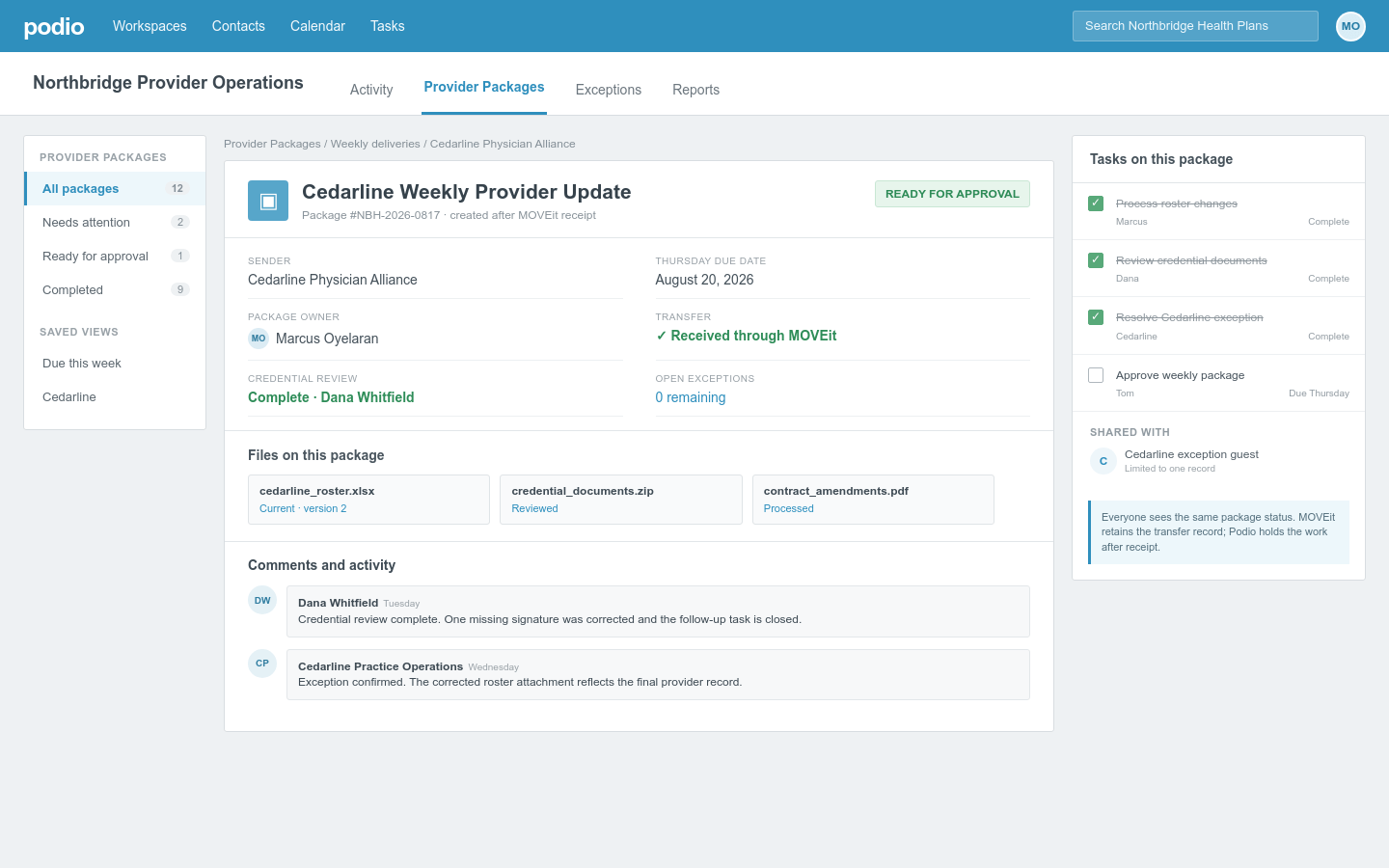
A Podio-style view of Northbridge’s Cedarline weekly provider package, including files, comments, assigned tasks and approval status
The following Monday, the first package opens in Podio after the transfer completes. Marcus finds his work waiting for him with due dates attached. When Cedarline sends its correction, he replaces the roster attachment instead of creating another copy. The earlier version remains available, but nobody has to guess which one is current.
On Tuesday, Dana records a missing signature on the package and assigns the follow-up to Marcus. She can see the same package he is working from, so the finding no longer disappears into her sent mail. Cedarline answers its exception on the record Northbridge shared. Marcus does not have to forward the reply or explain the thread.
By Thursday, Tom can see that the roster work is closed, Dana’s follow-up is complete and Cedarline has answered. Tom approves the package without asking anyone for an update. “That used to take a whole morning,” he says.
Two months later, another audit asks the same questions that led to the penalty. This time, Tom opens the package, reads who did what and shares that one package with the auditor, who sees nothing else. The answer that once took nine days to assemble is ready the same morning.

The team gets the Thursday answer
After a few weeks, Priya asks the team what they would keep about the new process. Nobody mentions the training. They talk about the work Podio took off their plates:
Northbridge’s package is a provider update, but the same week runs wherever recurring deliveries land, whether the folders hold invoices, loan documents or purchase orders. Four days of work follow a recorded transfer. Only the transfer leaves evidence behind.
Secure delivery does not complete the business process. Northbridge closed that gap by connecting two systems. MOVEit governs the movement of the file and proves it arrived. Podio governs the follow-on work that movement sets off—who owns each step, what is done, what is still open, who answered which question and when. A secure delivery becomes a completed outcome with a record. With Progress, Northbridge connects the transfer to a completed business outcome.
Treat secure file transfer and work management as one continuous process, not separate disciplines with a folder between them.
Start small. Map one week of your own recurring delivery. Give a due date and a name to every step you find sitting in someone’s memory. Start mapping those steps in your free Podio account.
And if you aren't already using MOVEit software to manage file transfers, schedule a demo today.
Continue reading...
Most organizations treat a file transfer as the end of a process. A document arrives, the system logs it and everyone moves on. But for the team on the receiving end, arrival is the beginning. Who reviews the file? Who owns each follow-up? What is still open? Who can prove any of it later? The answers usually live in email threads, spreadsheets and memory.
The transfer has a system of record. The work it sets off does not. This article explores what that gap costs, why it survives and how connecting a controlled transfer to visible, accountable work management closes it.
Every Monday at 6:00 a.m., the weekly provider update package arrives at Northbridge Health Plans, a fictional health insurer, through its Progress MOVEit file transfer system. The scheduled transfer completes at 6:01. That one minute is the only part of the week an automated system actually schedules and records. A minute later, the package passes into a weekly routine that runs on habit.
Cedarline Physician Alliance, the fictional physician group on the sending side, uploads that package every week, and Northbridge has until Thursday to confirm it is complete. In between runs a routine nobody designed. It has held together for three years, but not without a lot of wasted time.
The Transfer Is Recorded. The Work After It Isn’t.
Marcus Oyelaran, Provider Data Operations Manager, gets in before 8 a.m. and opens the download folder. Same routine, every Monday, held together by the two most dependable tools in enterprise IT: habit and Marcus. Only one of the two has ever taken a vacation.
He unpacks the package into four folders: roster changes, credential documents, contract amendments and exception reports. He logs the data on a new row of the spreadsheet he built three years ago. “One of these weekends I’ll rebuild it,” he thinks. Then the roster changes go in, keyed by hand.
Marcus keys the roster changes into his spreadsheet
At 10:20, Cedarline emails a late correction: two of the rows Marcus has already keyed in are wrong. Their whole explanation is “Oops!” He rekeys them and saves a corrected copy. I’d better save a backup copy of this for auditing, Marcus thinks as he creates another cedarline_providers.bak file.
Only Marcus knows which of the two copies is actually current.
After lunch, the credential documents go to Dana Whitfield, Compliance Lead, as an email attachment with no note about what changed. She saves the document to her personal shared folder and replies with where to find her review notes.
That leaves the exception report—one line Cedarline itself has to answer for. Late in the day, Marcus emails the question over to his contact at Cedarline’s practice operations desk, and the reply lands in a thread only he can read and decipher.
By Tuesday, the honest answer to “where does the Cedarline package stand” is “ask Marcus.”
Manual Transfers Have Lasting Implications: The Price of Work Without an Owner
Thursday is the day that confirmation is due. Producing that confirmation runs until nearly noon. Tom Brennan, VP of Provider Network Operations, needs to know whether the package is complete. Marcus’s spreadsheet says nothing about the credential review, so Tom messages Dana, then Marcus. The approval he assembles is the email itself, silent on which roster version it covered. There has to be a faster way, he thinks.
Tom spends the next hour assembling it. He pulls the roster count out of Marcus’s spreadsheet, digs Dana’s findings out of an email thread, opens the shared folder to see whether the contract amendments ever landed, then messages Marcus to ask which of the two roster files the count came from.
But nothing about that Thursday looks broken, which is how the routine survived three years. Three weeks later, an audit asks about an earlier package: who reviewed a specific credential and which roster version did the final approval cover? Marcus produces a transfer record and a spreadsheet row. Dana searches an email thread. Part of the answer depends on what two people remember about a Tuesday in March.
The response goes back nine days late, written up as a corrective action with a penalty. Tom, tired of the unnecessary penalties they receive, asks the question that starts the redesign: can the work after the transfer be assigned and recorded like the transfer itself?
Identifying the Pattern Problem
The question reaches the platform group, where Priya Raghunathan, Platform Architect, owns how work moves between systems. “Show me the week first,” she tells Tom. “Tools come last.”
She treats the weekly routine as an undocumented process and writes it down, recording every action between the transfer and the Thursday confirmation. Decisions leave no trace of who made them. The map runs to a dozen steps and shows the rest of what is missing every week:
- Marcus is the single source of status for the whole week
- No step has an owner of record
- The only due date is the one in Tom’s head
- Roster corrections pile up as new copies rather than replacing the old one
- Cedarline’s own exception is invisible to Cedarline
Every line on that map repeats one problem. The transfer has a system of record. The five days after that exist only in a spreadsheet and in Marcus’s memory.
Priya finds the pattern problem
Priya has one more requirement. Northbridge takes in four other recurring packages. She refuses to design a one-off fix for each. The original transfer uses MOVEit software today, so she asks Progress what handles the work after arrival. Progress recommends the Podio platform for automating workflows and coordinating collaboration in one workspace.
She turns the map into a standard package pattern. The whole delivery becomes one Podio item that holds the week’s files, tasks and comments, stamped with the sender and the Thursday due date. Every accountable step becomes a task with a named owner and a due date. The reviews that used to sit in sent mail become comments on that item, each one carrying its author and the time it was written. The roster file is attached once and replaced in place rather than copied.
Cedarline’s open exception becomes a record Northbridge can share with the sender alone.
Monday Morning Starts with Its Work Already Assigned
Priya connects MOVEit and Podio with one approved handoff step. When MOVEit finishes the Monday transfer, Podio creates the package item, stamps it with the sender and the Thursday due date. Podio then assigns the related tasks: the roster changes and contract amendments to Marcus, the credential review to Dana and the Thursday confirmation to Tom. Each task carries the name of the person who owns it and the date it is due. If nothing arrives on a Monday, that stays a transfer-side alert.
MOVEit controls the scheduled transfer and keeps the transfer record. From receipt onward, the package lives in Podio, including the history of what changed. Each product has its own access controls.
The Week Runs Without the Chase
Priya introduces the new process before the next weekly package arrives. She brings Marcus, Dana and Tom together and walks one package from receipt through Thursday approval. Instead of teaching them a new tool feature by feature, she shows each person where the work they already do will go.
Marcus is the hardest sell. His spreadsheet may be awkward, but it is his and he knows every tab. Priya shows him that the package will arrive with the roster changes and contract amendments already assigned to him. She is removing the retyping, not the judgment. He agrees to leave the spreadsheet closed for one week.
Marcus and Priya move the weekly process beyond the spreadsheet
Dana sees where her credential findings belong: as comments on the package, beside the documents she reviewed. If a finding needs follow-up, she can assign a task without starting another email thread. Tom gets a filtered view of the packages still in flight. Cedarline gets access only to its own exception, through a separately shared record.
A Podio-style view of Northbridge’s Cedarline weekly provider package, including files, comments, assigned tasks and approval status
The following Monday, the first package opens in Podio after the transfer completes. Marcus finds his work waiting for him with due dates attached. When Cedarline sends its correction, he replaces the roster attachment instead of creating another copy. The earlier version remains available, but nobody has to guess which one is current.
On Tuesday, Dana records a missing signature on the package and assigns the follow-up to Marcus. She can see the same package he is working from, so the finding no longer disappears into her sent mail. Cedarline answers its exception on the record Northbridge shared. Marcus does not have to forward the reply or explain the thread.
By Thursday, Tom can see that the roster work is closed, Dana’s follow-up is complete and Cedarline has answered. Tom approves the package without asking anyone for an update. “That used to take a whole morning,” he says.
Two months later, another audit asks the same questions that led to the penalty. This time, Tom opens the package, reads who did what and shares that one package with the auditor, who sees nothing else. The answer that once took nine days to assemble is ready the same morning.
The team gets the Thursday answer
What Changes After the Transfer
After a few weeks, Priya asks the team what they would keep about the new process. Nobody mentions the training. They talk about the work Podio took off their plates:
- Marcus: “I don’t type the package into a spreadsheet or sort through copies anymore. Podio gives me one current roster and shows me which tasks are mine. I can take a week off without the whole process turning into a search for Marcus.”
- Dana: “My findings stay with the package in Podio. I can leave a comment, assign the follow-up and see whether it was handled without digging through my sent mail.”
- Tom: “I open the Podio view and know which packages are ready and which ones still need attention. Thursday approval takes minutes because I don’t have to ask three people for the answer.”
- Priya: “Podio gave us a package pattern instead of another one-off process. We can use the same workflow for the next recurring delivery without rebuilding it around one person’s spreadsheet.”
Northbridge’s package is a provider update, but the same week runs wherever recurring deliveries land, whether the folders hold invoices, loan documents or purchase orders. Four days of work follow a recorded transfer. Only the transfer leaves evidence behind.
Secure delivery does not complete the business process. Northbridge closed that gap by connecting two systems. MOVEit governs the movement of the file and proves it arrived. Podio governs the follow-on work that movement sets off—who owns each step, what is done, what is still open, who answered which question and when. A secure delivery becomes a completed outcome with a record. With Progress, Northbridge connects the transfer to a completed business outcome.
Connect Your Own Business Outcome
Treat secure file transfer and work management as one continuous process, not separate disciplines with a folder between them.
Start small. Map one week of your own recurring delivery. Give a due date and a name to every step you find sitting in someone’s memory. Start mapping those steps in your free Podio account.
And if you aren't already using MOVEit software to manage file transfers, schedule a demo today.
Continue reading...