
Z
Zach Stone
Guest
Key Takeaways for SEO and GEO in 2026:
- SEO, AEO and GEO form a unified practice serving three distinct audiences. While the fundamentals are similar, their emphasis varies.
- Implementing structured data is the most impactful action this year, as LLMs rely on it even more than traditional search engines.
- Your CMS largely determines your team's ability to execute these strategies. Select your platform carefully.
- Securing citations in AI Overviews is now more valuable than pursuing the clicks those overviews have replaced.
- Reference rate, rather than click-through rate, is the key metric for generative responses.
Last month, I co-presented two webinar sessions with the Progress Sitefinity team: "From Invisible to Discoverable: Practical SEO and GEO Strategies in Progress Sitefinity." One session targeted EMEA, the other North America. Both exceeded their scheduled time and generated more questions than could be addressed live.
Across both regions, attendees no longer asked what GEO is.
Instead, they focused on implementation: how to build content, technical foundations and CMS configurations that drive visibility in both traditional and AI search results.
One survey respondent noted the live session "skimmed the surface," which is a fair assessment.
This post provides more in-depth exploration, structured around attendee interests.
What You'll Learn About SEO and GEO
I lead the marketing team at DeltaV Digital and have over 15 years of experience in SEO, with recent years focused on AEO and GEO. DeltaV has partnered with Progress Software for nearly eight years, which led to my invitation to co-deliver the webinar with the Sitefinity team.
Some examples reference Sitefinity CMS, reflecting survey respondents' interests but the playbook is applicable to any modern content management system.
Main topics covered:
- How to approach SEO, AEO and GEO (and AI search optimization more broadly) as a unified practice
- Why schema is the most impactful action for 2026
- How your CMS can either enable or hinder these efforts
- Common technical mistakes, even among experienced teams
For broader context on how AI is reshaping search: Search in 2025: The Rise of AI, User Generated Content and Future of SEO.
SEO and GEO Are One Practice with Two Audiences
A common client assumption is, "We need to start a GEO strategy now," implying GEO is a separate discipline from SEO. This is not the case.
The term "generative engine optimization" was coined in a November 2023 research paper by researchers from Princeton, Georgia Tech, the Allen Institute for AI and IIT Delhi (Aggarwal, Murahari, Rajpurohit, Kalyan, Narasimhan, Deshpande).
The paper demonstrated that targeted optimization can increase visibility in generative responses by up to 40%. Techniques such as citing sources, including statistics, promoting semantic clarity and quoting experts are extensions of existing SEO practices.
The most effective techniques included adding citations, statistics, quotations and authoritative language, all of which extend established SEO practices. The study also tested keyword stuffing, which did not improve results.
The Relationship Between SEO, AEO and GEO
SEO (search engine optimization) optimizes ranking in traditional search results.
AEO (answer engine optimization) optimizes the answer surfaced in featured snippets, People Also Ask and increasingly AI Overviews. Search engines have been moving in this direction since structured data and rich results were introduced.
GEO (generative engine optimization) optimizes for being cited inside generative responses (AI Overviews, ChatGPT, Perplexity, Gemini, Claude, etc.).
All three share similar fundamentals but serve different audiences.
A Useful Mental Model
Consider a scenario where a human reader, Googlebot and an LLM all visit the same page.
Each should come away with the same understanding. If your page serves only one, there is a gap.
What Is Genuinely New in GEO
Large language models (LLMs) process content differently than crawlers reading rendered HTML. They rely more on structured data, semantic markup, authoritative citations and topical depth. The optimization stack remains the same but the emphasis shifts.
This is where DeltaV Digital's GEO services live. The broader point holds regardless of who runs your program: the work to win in LLMs is mostly the work to win in search, done with more rigor.
The AI Overview (AIO) Trade-off Everyone Keeps Asking About
The strongest question in the North American session came from an attendee at a US insurance carrier:
"If AI Overviews answer the query, are we losing clicks? Why would we want to be cited?”
This question warrants a more detailed response than was possible during the live session.
Before getting to the bad news, the scale matters. Google still serves an estimated 14 billion searches per day.
ChatGPT serves around 37 million. That is a 210-to-1 ratio.
The shift to AI search is significant and clear but traditional search volumes remain substantial. It is important to optimize both.
The Bad News
Click-through rates on traditional position-one results drop sharply when an AI Overview is present:
- Ahrefs measured a 58% drop at position one across a 300,000-keyword sample.
- Seer Interactive's longitudinal study of informational queries, found a 61% organic CTR decline.
- BrightEdge measures AI Overviews on roughly 48% of all Google searches as of early 2026, with the rate climbing.
A Less Obvious Consideration
Being cited in an AI Overview is not the same as being skipped.
Seer's data also showed brands cited inside an AIO result see a 35% higher organic CTR overall on those queries.
This effect mirrors the impact of strong SERP snippets: increased brand exposure leads to higher click intent in subsequent queries.
The underlying decision is straightforward. If a query will display an AIO regardless, your options are:
- Being cited inside it (brand visible, some clicks, downstream lift).
- Being absent (no impression, no clicks, no compound effect).
Being Cited Beats Being Absent
However, not every query warrants AIO optimization. Top-of-funnel definitional queries may no longer be viable. Focus on mid- and bottom-funnel queries with commercial intent for the best return.
A Note on Metrics
The traditional measure of SEO success was rankings and click-throughs. The emerging measure for GEO is reference rate, the share of generative responses for a given query set that mentions or cites your brand. Tools like Profound, Scrunch and Peec AI report this directly. If your team is still benchmarking rankings alone, you are measuring the visible half of a conversation that increasingly happens in places where rankings do not apply.
Recommendation: Monitor AIO presence on your top 25 to 50 commercial queries. Prioritize queries where AIOs are dominant but your brand is not cited. For queries without stable AIOs, traditional SERP optimization remains effective.
The Sitefinity AI Searchability solution is one example of CMS-level support for being discoverable in this new landscape.
Why Schema Is the Most Impactful Move of 2026
While search engines can render JavaScript and infer structure, LLMs are less reliable in this regard. Structured data provides the clearest and most consistent signal.
It is also why one attendee's question hit harder than it would have a year ago: what happens to FAQ content hidden inside a collapsed accordion until the user clicks?
Google has long stated that user-initiated content reveals are acceptable. However, LLMs may not execute the JavaScript required to display these answers. Schema addresses this by exposing full question-answer pairs through JSON-LD, independent of the visual UI.
Entity Recognition: An Overlooked Aspect of Schema
Structured data not only aids crawlers in indexing pages but also establishes your brand, products, services and authors as recognizable entities within LLMs' internal representations.
Using Schema.org's @id pattern, consistent Organization markup, sameAs references to social profiles and Wikipedia/Wikidata entries and named Person schema for authors all reinforce entity recognition.
In practice, brands with clean and consistent entity markup are more likely to be cited in generative responses than those mentioned only in unstructured content.
Entity clarity remains an under-appreciated aspect of GEO.
Where to Implement Schema
Organization schema should be implemented once, sitewide; typically on the homepage, though an About page is also acceptable. Use the @id pattern to allow other schema blocks to reference it without duplication. This was a direct question from a digital agency during the webinar.
- FAQPage schema is applied at the page level and depends on content. Manage it within your CMS rather than through hard-coded templates, enabling business users to retain editorial control without requiring deployments.
- Article or BlogPosting schema should be dynamic at the content level. Templates provide the structure, while content fields supply dynamic values.
- Product, Service, Event, Course, Recipe and other entity-specific schemas should correspond to the relevant content types you use.
Principle: Every meaningful content type should have an appropriate schema implementation.
One important caveat as of May 7, 2026: Google stopped showing FAQ rich results in Search. The FAQ search appearance, rich result report and Rich Results Test support are being removed in June 2026 and Search Console API support follows in August 2026. The Schema.org FAQPage type itself remains valid and Google has confirmed it will continue to use FAQ structured data to understand pages even though it will not display the rich result.
For GEO, FAQPage schema remains important. While the rich snippet was the SEO benefit, the structured signal for LLMs, which often cannot execute JavaScript to reveal FAQ answers, continues to provide value for GEO.
What Changed at the CMS Layer in 2026
Several modern CMS platforms now offer native schema generation.
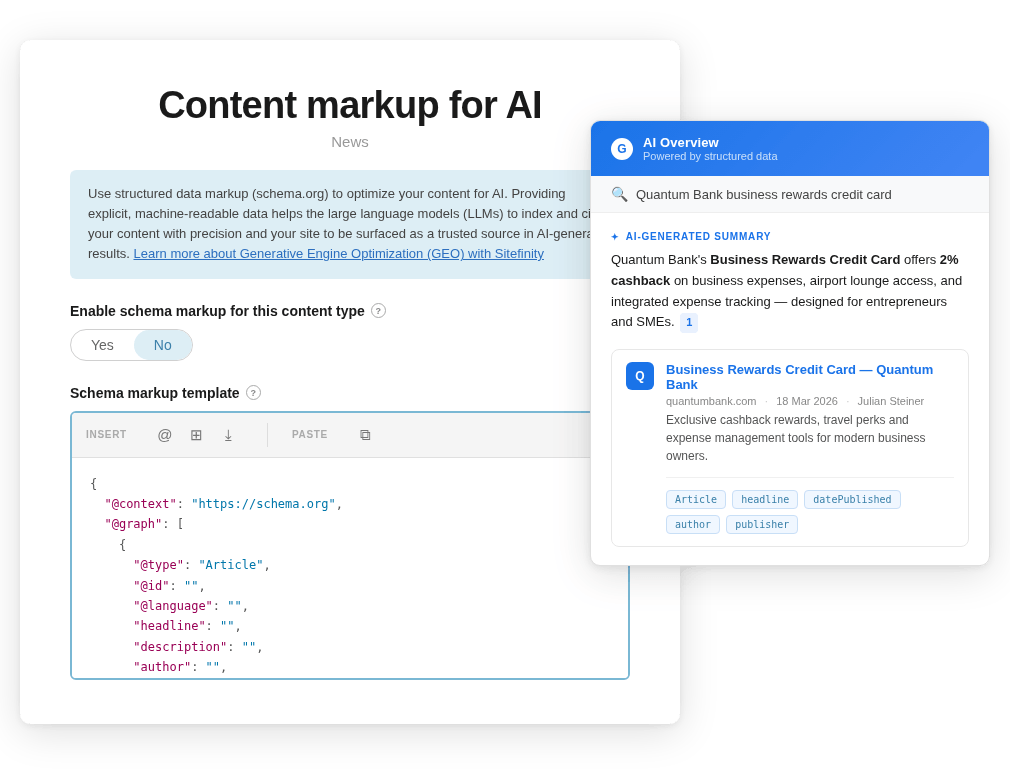
For example, the Sitefinity 15.4.8626 release introduced AI-Friendly Structured Content, which generates Schema.org JSON-LD from existing content fields, taxonomies and relationships. Two aspects make this significant, regardless of platform:
- It eliminates the need for a developer build for each new schema type. Editorial teams can manage schema directly within the content management interface.
- Schemas are properly structured: page-level and content-level schemas render in separate JSON-LD blocks, aligning with Google's standards. This was clarified during the webinar Q&A.
If you take only one action after reading this, prioritize the following:
- Confirm that Organization and WebSite schemas are present once, sitewide (usually on homepage or about).
- Confirm WebPage schema renders on every page.
- Add entity-appropriate schema to each high-value content type.
- Validate your schema output using Schema.org's reference documentation and Google's Rich Results Test.
To learn more about schema, check out: How to Win the SEO Battle: Taking Advantage of Structured Data
Beyond Schema: How LLMs Parse Your Page
Structured data is one signal; the structure of your prose is another. Generative engines more effectively extract content that clearly indicates its structure. Three helpful habits include:
- Use summary phrases. Sentences beginning with "In summary," "The key point is," or "The takeaway is" are frequently cited by LLMs.
- Use lists for enumerable content, such as three reasons, five steps or seven principles. Lists are consistently parsed across all retrieval systems.
- Front-load the answer by leading each section with the conclusion, followed by supporting arguments and evidence. This approach aligns with both editorial best practices and LLM preferences.
These are established SEO practices, now applied to a new audience.
How Your CMS Can Either Enable or Hinder These Efforts
Even with strong strategy and content, a restrictive CMS can undermine your efforts.
This challenge typically appears in three areas:
- Schema management. If your CMS forces structured data through templates only, business users cannot iterate. Sitefinity's recent move to schema auto generation from content fields is one example of how CMSs are responding. WordPress plugins, Drupal Schema.org module and Adobe Experience Manager's structured content models are others. The pattern matters more than the tool.
- Semantic flexibility: Some CMSs promote hard-coded HTML structures that lack semantic markup. The best platforms allow content teams to control heading hierarchy, body structure and metadata without custom development. Without this, pages may use non-semantic elements, making them difficult for crawlers and LLMs to interpret.
- Page-level SEO controls: Editors should be able to manage titles, meta descriptions, canonicals, robots.txt directives, Open Graph and LLM-relevant fields on a per-page basis without engineering support. Choose SEO-native CMS platforms where these controls are integrated features.
The questions to ask of your CMS platform (regardless of brand):
- Can my editorial team manage schema on a per-page or per-content-type basis without deployment?
- Does the CMS emit valid, current Schema.org markup that compounds correctly across page and content layers?
- Can editors set canonicals, redirects and noindex without engineering?
- Are custom widgets and components built with semantic HTML by default?
- Is there native support for AI-assisted optimization, or do we need to bolt a third-party tool for every gap?
Regarding "marketing and IT collaboration," most friction between these teams arises at the CMS layer. Improved understanding of available tools can reduce the need for negotiation.
The Developer-Side Mistakes Even Mature Teams Still Make
Marketers often view SEO as a content issue.
Developers often see it as a configuration problem.
In reality, it is both. The disconnect between these perspectives often leads to missed opportunities in rankings.
Three common issues identified in most audits, regardless of CMS:
- Hard-coded text in templates: For example, rendering a "Learn More" button as static text rather than pulling from a content field undermines personalization, localization and SEO. The solution is consistent across platforms: use dynamic content for any descriptive string. In Sitefinity, set custom values for widget templates from content type fields; other CMSs offer similar content modeling options.
- Visual headings without semantic HTML: Styling a <p class="heading-1"> to appear as an H1 does not provide the necessary structure for crawlers and LLMs, which rely on actual tags. This is a costly mistake. Audit templates for correct tag usage, not just visual styling.
- Custom widgets and components lacking SEO awareness: While most CMSs provide best-practice components, custom elements may not. Interactive features such as tabs, accordions, carousels and modals require explicit review for crawlability, semantic structure and structured data.
The Marketing and IT Collaboration Gap
In the post-webinar survey, several respondents flagged this gap as their most-wanted future topic.
The underlying challenge in all three issues is accountability. Marketing and engineering often view SEO as the other's responsibility, leading to shared credit for successes and blame for failures.
A helpful reframe is to view issues as opportunities: "Good, now we know and can fix it." Setbacks can become setups for future success.
Former Navy SEAL Jocko Willink refers to this as the Philosophy of Good.
When these issues arise, the mindset should be, “Good, now we know and can fix it!”
Let us turn setbacks into opportunities for success.
The most effective approach is a monthly 30-minute SEO and engineering meeting, where one engineer is responsible for reviewing the structure of new templates, widgets and components before deployment. No new tools are needed—just a recurring meeting with a rotating owner.
Alt Text, Anchor Text and Commonly Overlooked Basics
The European Accessibility Act has appropriately prioritized accessibility.
The primary purpose of alt text is to accurately describe images for screen reader users. Any SEO benefit is secondary.
Two patterns I find in most audits:
- Keyword-stuffed alt text on unrelated stock photos is unhelpful and signals low quality.
- Meaningful images, such as product photos, diagrams or screenshots, often lack adequate alt text. Treat this as essential content and describe them accordingly.
Practical rule: Write alt text as if explaining the image to someone over the phone. Include relevant terms naturally but do not force them.
Anchor Text Follows the Same Principle
During the EMEA Q&A, accessibility and anchor text were discussed. Descriptive anchor text aids screen reader navigation, helps search engines understand link context and assists LLMs in following citation chains. Generic phrases like "Click here" are ineffective; specific, descriptive anchors are preferable.
Another frequently overlooked basic is heading hierarchy.
Use a single, logically placed H1 per page. Multiple H1s are a common audit issue and can be corrected by content teams without developer involvement.
Canonicals, Redirects and the Critical Implementation Details
Two attendees inquired about canonicals for dynamic content detail pages. Most modern CMSs, including Sitefinity, generate canonicals by combining the detail page URL with the content item URL.
Ask whether the same content item is accessible through multiple detail pages. If so, you must designate a single canonical URL.
Audit recommendation: List all dynamic content types and their associated detail pages, then confirm a single canonical strategy is enforced. Modern CMS SEO controls and in-CMS AI agents can help automate this but human review remains important for cross-sectional content.
Other implementation details from the Q&A include:
- Redirects on URL changes. Map every 404 error from your logs to the new URL structure during site reorganizations. This simple task is often overlooked until rankings are affected.
- Sitemaps: Automate sitemap generation, provide inclusion of AI-relevant content types and validate after any structural changes.
- Robots.txt directives. Audit at least annually. Confirm what you intend to block is blocked and what you intend to crawl is reachable.
These are not exciting. They are also where the easiest wins still live.
The Rise of In-CMS AI Agents (and Their Limits)
A new category emerged across multiple CMS vendors in 2026: AI assistants embedded directly in the editor.
Sitefinity shipped two relevant ones in the 15.4 update: an SEO Agent and a Brand Agent. Adobe Experience Manager, Contentful, Drupal and others are shipping comparable capabilities.
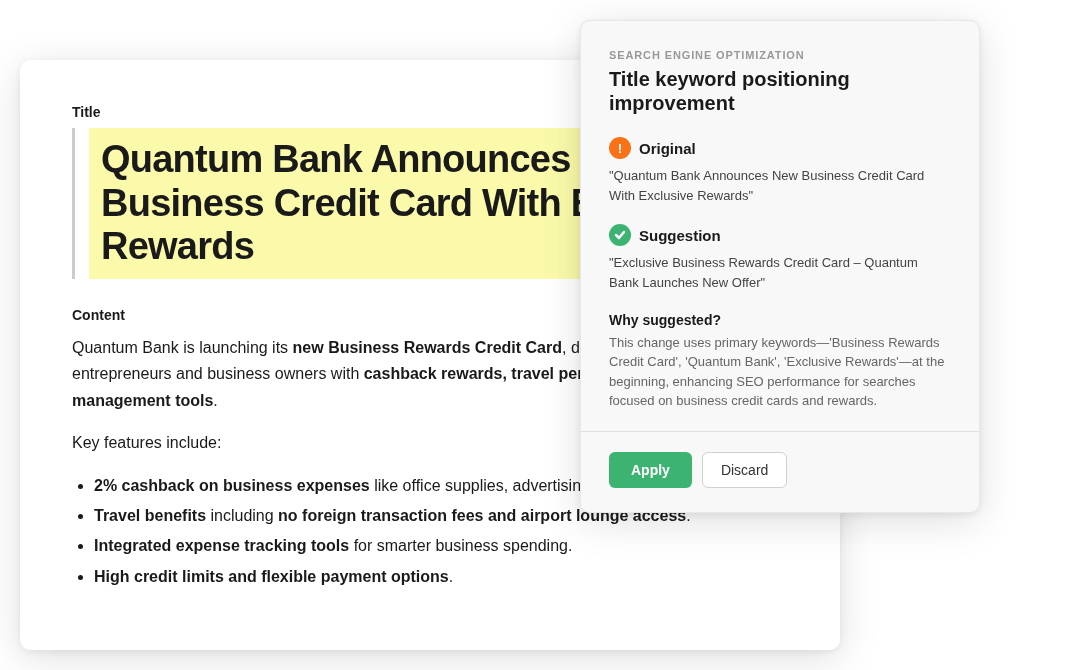
What this category does well:
- Reviews content against SEO best practices and surfaces recommendations inside the editor.
- Catches issues at the point of creation, before publication.
- Genuinely useful for high-volume content programs where a human SEO cannot review every page.
What it does not replace:
- Strategy.
- Schema architecture.
- Topical clustering and content road mapping.
- Canonical decisions on dynamic content.
- Anything requiring judgment about brand position or business priorities.
Think of these agents as a strong senior editor who reviews every page before it ships. That is genuinely valuable. It is not a substitute for an SEO strategy.
AI Performance Monitoring
A separate category every team needs to know about.
External AI visibility monitoring tools track how often a brand is cited in generative responses across LLMs. The leading platforms as of early 2026 are Profound, Scrunch and Peec AI, with SEMrush, HubSpot and others entering the space.
These tools answer a different question than in-CMS agents: "Where do I show up in the AI ecosystem and on which queries?"
If you are serious about AEO/GEO, you need both kinds of visibility. The in-CMS agent improves what you ship; the external monitor tells you what to ship next.
A Practical Checklist to Start This Quarter
If you are not sure where to start, focus here:
- Audit structured data coverage. At minimum: Organization and WebSite (sitewide), WebPage and entity-appropriate schemas (Article, FAQPage, Product, Service, Event) on every relevant content type. Validate with Google's Rich Results Test.
- Turn on native schema generation where your CMS supports it. If you are on a modern CMS that ships this capability (Sitefinity, recent Adobe Experience Manager, Drupal with the Schema.org module, etc.), enable it and verify the output.
- Verify accessibility fundamentals. Alt text on every meaningful image, descriptive anchor text, correct heading hierarchy. EAA makes this non-negotiable for European-facing sites; the SEO and GEO benefits are free.
- Stand up AIO and citation monitoring on your top 25 commercial queries. Use Scrunch, Peec AI, Profound, SEMrush or any tool with comparable coverage. Without this data, GEO investment is guessing.
- Audit your canonical and redirect strategy. Especially for dynamic content with multiple possible URLs. One canonical per content item; clean redirect chains.
- Schedule a monthly SEO and engineering sync. Review new templates, widgets and components before they ship. No new tools. Just a recurring meeting and a rotating owner.
- Commission a structured data and SEO audit if your last one is over 12 months old. The standards moved faster in the last 18 months than in the prior 10 years.
Watch the SEO and GEO Webinars On Demand
The webinar walks through the new schema auto generation tool on actual content, plus the on-page SEO walkthrough on a real banking site example and the audience Q&A in full.
Watch the From Invisible to Discoverable webinar recording
Want to think bigger than the checklist? The Sitefinity team also recorded a strategic follow-up: Strategizing for SEO/GEO Success in 2026 and Beyond.
Watch it on demand if you are mapping out the next 12 to 18 months.
Frequently Asked Questions About SEO & GEO
What is generative engine optimization?
GEO is the practice of optimizing content to be cited and surfaced inside generative engines such as Google's AI Overviews, ChatGPT, Perplexity, Gemini and Claude.
The term was formally introduced in a November 2023 research paper from Princeton, Georgia Tech, the Allen Institute for AI and IIT Delhi.
What is the difference between SEO, AEO and GEO?
SEO optimizes ranking in traditional search results.
AEO (answer engine optimization) optimizes for being the answer in featured snippets, People Also Ask and AI Overviews.
GEO optimizes for being cited inside generative responses across the broader LLM ecosystem.
The fundamentals overlap heavily. The audience differs.
Learn more about the difference between AEO, GEO and SEO
Is GEO the same as traditional SEO?
No but they share most of their underlying disciplines. Both rely on structured content, authoritative citations, semantic markup and topical authority.
GEO weights structured data and citation patterns more heavily because LLMs consume content differently than crawlers do.
Learn more about AI Search vs Traditional Search: Rethinking Search in the Age of AI
How do I optimize for AI Overviews?
In priority order: implement comprehensive structured data, provide semantic HTML markup, build topical authority through related content, earn external citations and brand mentions and monitor AI Overview presence on your top commercial queries.
Learn more about the SEO impact of AI-driven content
How does my CMS impact SEO and GEO?
Significantly. The CMS controls how easily editors can manage schema, canonicals, metadata, redirects and accessibility.
Modern CMSs are starting to ship native schema generation and in-editor SEO agents, which materially shortens the gap between strategy and implementation.
Continue reading...