
S
Suzanne Scacca
Guest
Stories, familiarity and curiosity can help stick your brand in the memory of your prospect for when they’re ready to engage.
A memorable brand is one that has a leg up on the competition. Not only have they found a way to differentiate their business model from their peers, they’ve found a way to leave a lasting impression on consumers’ minds.
In this post, we’ll explore three research-backed strategies you can use to create a brand that’s more memorable.
Turning cold and warm leads into customers takes time. According to Tooltester, it can be anywhere from five to 50 touches/interactions to turn a lead into a customer. Even inactive customers may need multiple touchpoints as well (between one and three).
So you need to make every interaction count.
By making your brand one that’s easier to remember, you won’t have to constantly reestablish who you are with each touchpoint. If you’re looking to try this out, here are some research-based techniques that can help improve memorability:
There was a study published in 2022 on “Stories, Statistics and Memory.” The aim of the research was to determine what kind of information campaigns tend to stick more effectively in the minds of consumers. Specifically, the researchers looked at storytelling versus the sharing of statistics and facts.
To evaluate the staying power of each type of content, they measured how rapidly the content faded from users’ minds over the course of a day. On average, stories faded by 33%; statistics faded by 73%.
But why does this happen? You might think that learning a single, powerful statistic would be easier to remember than a whole story.
In reality, it’s not the brevity of the information shared that makes it so memorable.
For starters, statistics can be difficult to remember unless you’re actively studying them to be recalled at a later time. We have so many numbers thrown at us in our lives—addresses, phone numbers, dates, metrics, measurements and so on. A statistic has to have a ton of potency and relevancy to be memorable.
Now, not all stories are memorable either. However, stories with unique, distinctive and/or surprising details can improve recall. While users might not remember the entire story, they likely will remember standout details.
As for which details improve memorability, you want to focus on reality versus concepts. When we share statistics, we’re asking someone to envision the concept of a number or percentage.
It’s hard for our minds to form a clear idea around this. Yes, we get that there’s improvement and it’s impressive that more than four-fifths saw improvements in their studies. But there’s not much else there to work with.
When we share stories with others, we’re painting a mental picture. We describe the place, the people, the problem and resolution, etc. For example:
Storytelling is a powerful tool in marketing. With it, we can:
It can be difficult to watch your child struggle in school, especially when you see them putting in the work. This story encapsulates that situation much more effectively than a statistic. Parents who relate to this situation may actually see their child struggling with their studies and coming home crying when they hear the story told.
This isn’t to say that statistics aren’t useful in marketing. If you’re looking to quickly convince someone that your products or services are more effective than the competition’s, a statistic may be able to persuade the prospect’s decision. But if you want a prospect to really remember what it is that differentiates you from the pack, stories are the way to go.
There’s a phenomenon called the Mere-Exposure Effect. It describes our preference for something because it feels familiar.
How does this play into memory? Well, studies have proven that repeated exposure improves recognition.
Here’s an example of how the Mere-Exposure Effect works:
You’re watching something on YouTube and an ad comes on for AutoZone.
You watch it, but barely. You’ve seen AutoZones as you drive around town. You just never give them much thought.
It seems like every few days, you see or hear another ad for AutoZone—on YouTube, the TV, Instagram and even the radio. Again, it doesn’t really trigger a need or much interest in you. But you’re now joining in and singing the jingle at the end.
You get into your car a couple months later and the oil light is illuminated on your dashboard. What do you think of? For some people, it means a trip to the autobody shop to get the oil changed. For more DIY types and gearheads, you might prefer to do it yourself. And, realistically speaking, if this ad targeted you, you’d probably fit into that segment. So, you might be thinking about a quick trip to AutoZone for oil.
This is how brands can use the Mere-Exposure Effect to increase the frequency with which target users encounter their brand.
This is why regular marketing in the form of blogging, newsletters and social media is so valuable for brands. Even if prospects aren’t ready to convert today, you’re becoming a more familiar (brand) face with each interaction.
Multi-channel marketing and advertising will help, too. That way, users don’t become blind to your content or ads if they repeatedly encounter them on the same platform. A new setting and different content will allow you to recapture their attention.
Just be careful about overdoing it. Consider running tests to find the best days/times to put your content in front of people. Also test the frequency with which you publish content or show ads. You’ll want to find the sweet spot where they recognize your content without feeling like it’s become intrusive or annoying.
In a 2014 study published in Cell, they sought to understand why people learn new topics more effectively when it’s something they’re curious about. Using functional magnetic resonance imaging (MRIs), they studied how the brain responded to different types of information.
The researchers compared how much information people would retain and for long when it was intrinsically motivated (i.e., curiosity) versus externally rewarded. In the end, they found that activity in key parts of the brain was enhanced when curiosity was the driving force.
Let’s use the example of reading.
When you were in school, you were assigned countless books to read. You’d have to complete certain chapters each night or week, and then complete assignments or tests related to them.
How many of the assigned books do you still remember to this day? Some of the stories may have resonated with you to the point where you remember them or at least certain details from them. For instance, there was a book called Night by Elie Wiesel that we had to read in high school. Although I enjoyed it at the time, all I can remember about it now is that it was set during the Holocaust.
Compare that to the books you’ve read on your own over the years.
How many of them do you remember? You might not recall all of them or every perfect detail, but I have a feeling they’re much clearer in your mind than what you were assigned to read. For instance, I read Stephen King’s The Stand around the same time as Night. It has more than 1,100 pages and dozens of characters in it. I can still tell you who they were and describe the plot and high points.
So, knowing this, how do we translate this concept to branding and marketing?
If we’re looking at this on a larger scale, you want there to be curiosity around your brand. If you can surprise people, present them with a novel concept or have them longing for answers, you’ll increase the memorability of your brand.
For some brands, this might not be realistic. If your company offers something that many others do (think of like a plumber or an IT services provider) or you don’t want there to be any surprises or shocks when it comes to your brand, then you might not be able to leverage curiosity in that way. But you certainly can with the marketing content or ads that you run.
I’ll give you an example. I follow a lot of local farms in Florida and Georgia on Instagram. I enjoy learning about what they produce and seeing what kinds of events they host. So, this kind of content is nothing new.
But earlier today, I was scrolling through my feed when this post was recommended by @thefarmatokefenokee:
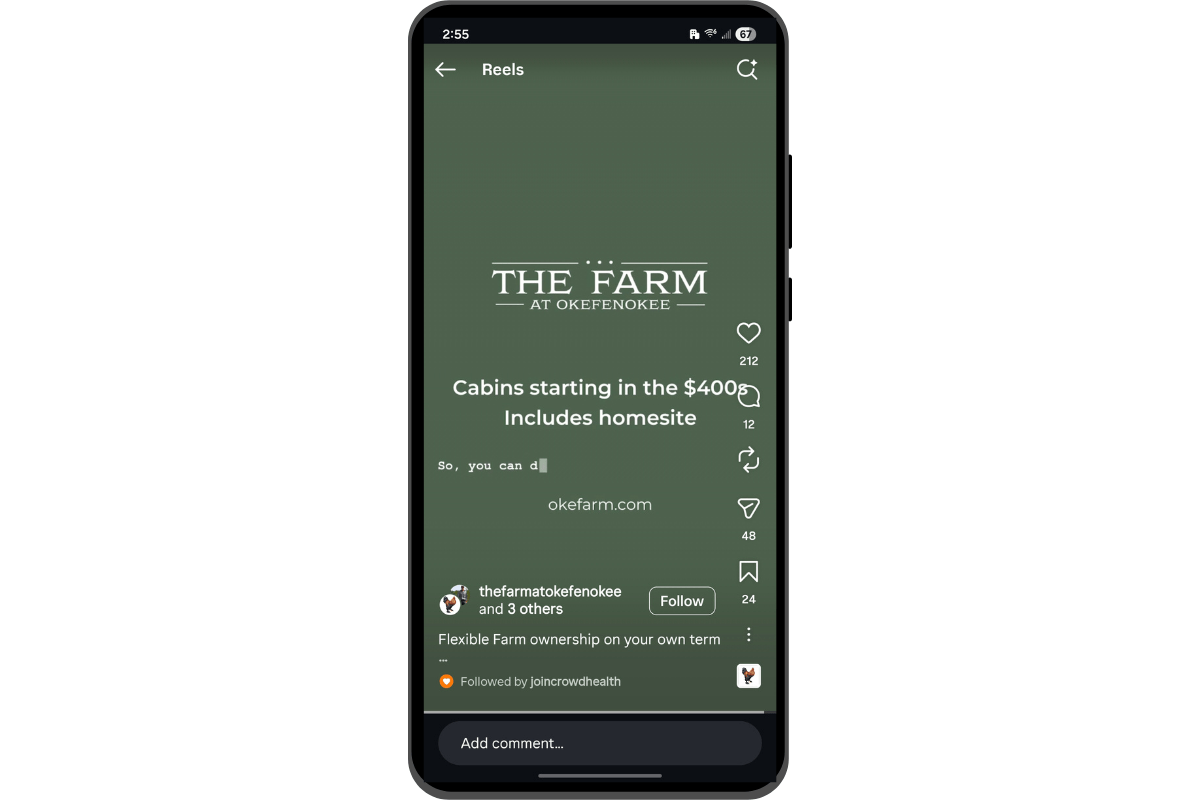
In the video, co-owner Doug Davis answers the question:
I was initially confused. This is the first time I’ve encountered this farm on my feed, so I didn’t understand why visitors would have to work there. It definitely piqued my interest. As I watched the video, I realized he’s talking about an opportunity to buy land and a cabin on the farm.
This is what I mean by smaller-scale curiosity. You can use your website or app, social media posts, blog, and even ads to address questions or matters that get users to stop and say, “Wait a minute. What is this about?”
I might not be in the market for homeownership. However, finding this post allowed me to discover that this farm has other appealing opportunities, like visits with the animals, overnight stays and farm-to-table meals. It’ll definitely be a while before I forget about this farm.
If you can get your content in front of targeted prospects and pique their interest, you’ll make a strong impression on them, too.
Is memorability the only thing that matters? Consider it from the perspective of the user:
You’re at a party and talking to your brother-in-law and sister about how your tooth aches. They recommend a dentist who happens to be there. He introduces himself, mentions his business name, says his office is downtown and invites you to visit his website and book an appointment.
You walk around the party and you’re hit with pain when you take a sip of your drink. Someone notices and introduces himself as a dentist. He works on Main Street right next to that coffee shop you love. Then he tells you about a woman who came in with persistent toothaches. She didn’t have cavities. The problem turned out to be gum recession. Since her treatment, she’s been pain-free for six months. He gives you his business card and tells you to call him.
Which of these dentists would you end up contacting?
Both were local and seemed professional. The first one was recommended by your brother-in-law and sister, but you can’t remember much about him or even the name of his office. You could always call your sister to get the info, but you can’t stop thinking about the other dentist and the story about the woman with tooth pain. Plus, you have his business card, so you can look him up right now.
Does a personal brand recommendation trump a brand that gives a stronger and longer-lasting impression?
I think it depends on the context. Someone who’s had bad experiences with dentists may prefer the personal recommendation, even if it means jumping through some hoops to get the info. On the other hand, some people may find the second dentist’s proactive and empathetic approach to be more reassuring. But that’s how it goes in marketing. We try different strategies in the hopes of connecting with as many people as possible.
That said, it’s important not to conflate memorability with trustworthiness. There are plenty of brands with memorable slogans, brand packaging and messaging that have a less-than-stellar reputation. So the memory-building strategies above need to be used in combination with ethical brand-building strategies in order for the memorability effect to be worthwhile.
Brand consistency has always mattered, but with AI search now driving first impressions, this importance is amplified more than ever. If LLM inputs are inconsistent, the output will be too.
Continue reading...
A memorable brand is one that has a leg up on the competition. Not only have they found a way to differentiate their business model from their peers, they’ve found a way to leave a lasting impression on consumers’ minds.
In this post, we’ll explore three research-backed strategies you can use to create a brand that’s more memorable.
3 Ways to Make Your Brand More Memorable
Turning cold and warm leads into customers takes time. According to Tooltester, it can be anywhere from five to 50 touches/interactions to turn a lead into a customer. Even inactive customers may need multiple touchpoints as well (between one and three).
So you need to make every interaction count.
By making your brand one that’s easier to remember, you won’t have to constantly reestablish who you are with each touchpoint. If you’re looking to try this out, here are some research-based techniques that can help improve memorability:
1. Tell Stories vs. Statistics
There was a study published in 2022 on “Stories, Statistics and Memory.” The aim of the research was to determine what kind of information campaigns tend to stick more effectively in the minds of consumers. Specifically, the researchers looked at storytelling versus the sharing of statistics and facts.
To evaluate the staying power of each type of content, they measured how rapidly the content faded from users’ minds over the course of a day. On average, stories faded by 33%; statistics faded by 73%.
But why does this happen? You might think that learning a single, powerful statistic would be easier to remember than a whole story.
In reality, it’s not the brevity of the information shared that makes it so memorable.
For starters, statistics can be difficult to remember unless you’re actively studying them to be recalled at a later time. We have so many numbers thrown at us in our lives—addresses, phone numbers, dates, metrics, measurements and so on. A statistic has to have a ton of potency and relevancy to be memorable.
Now, not all stories are memorable either. However, stories with unique, distinctive and/or surprising details can improve recall. While users might not remember the entire story, they likely will remember standout details.
As for which details improve memorability, you want to focus on reality versus concepts. When we share statistics, we’re asking someone to envision the concept of a number or percentage.
“82% of children who used our flash cards performed better in math classes.”
It’s hard for our minds to form a clear idea around this. Yes, we get that there’s improvement and it’s impressive that more than four-fifths saw improvements in their studies. But there’s not much else there to work with.
When we share stories with others, we’re painting a mental picture. We describe the place, the people, the problem and resolution, etc. For example:
“My son was failing his third grade math class. He failed test after test, no matter how long he studied at his desk every night. That’s when me and my wife came up with these flashcards. They were specially designed with colors and graphics that were shown to improve memorability. We practiced daily with him for weeks. On that next test, he got a B-minus! He was so proud of himself! Since then, MemoMath Cards have helped 12,000+ parents and their kids make big strides in learning!”
Storytelling is a powerful tool in marketing. With it, we can:
- Show empathy for our users’ pains or obstacles
- Paint a mental picture that depicts how the pain was resolved
- Provide more relatable and realistic details about our solution
- Connect with users on deeper emotional levels
It can be difficult to watch your child struggle in school, especially when you see them putting in the work. This story encapsulates that situation much more effectively than a statistic. Parents who relate to this situation may actually see their child struggling with their studies and coming home crying when they hear the story told.
This isn’t to say that statistics aren’t useful in marketing. If you’re looking to quickly convince someone that your products or services are more effective than the competition’s, a statistic may be able to persuade the prospect’s decision. But if you want a prospect to really remember what it is that differentiates you from the pack, stories are the way to go.
2. Use Frequency to Become a Familiar Face
There’s a phenomenon called the Mere-Exposure Effect. It describes our preference for something because it feels familiar.
How does this play into memory? Well, studies have proven that repeated exposure improves recognition.
Here’s an example of how the Mere-Exposure Effect works:
You’re watching something on YouTube and an ad comes on for AutoZone.
You watch it, but barely. You’ve seen AutoZones as you drive around town. You just never give them much thought.
It seems like every few days, you see or hear another ad for AutoZone—on YouTube, the TV, Instagram and even the radio. Again, it doesn’t really trigger a need or much interest in you. But you’re now joining in and singing the jingle at the end.
“Get in the zone. AutoZone.”
You get into your car a couple months later and the oil light is illuminated on your dashboard. What do you think of? For some people, it means a trip to the autobody shop to get the oil changed. For more DIY types and gearheads, you might prefer to do it yourself. And, realistically speaking, if this ad targeted you, you’d probably fit into that segment. So, you might be thinking about a quick trip to AutoZone for oil.
This is how brands can use the Mere-Exposure Effect to increase the frequency with which target users encounter their brand.
This is why regular marketing in the form of blogging, newsletters and social media is so valuable for brands. Even if prospects aren’t ready to convert today, you’re becoming a more familiar (brand) face with each interaction.
Multi-channel marketing and advertising will help, too. That way, users don’t become blind to your content or ads if they repeatedly encounter them on the same platform. A new setting and different content will allow you to recapture their attention.
Just be careful about overdoing it. Consider running tests to find the best days/times to put your content in front of people. Also test the frequency with which you publish content or show ads. You’ll want to find the sweet spot where they recognize your content without feeling like it’s become intrusive or annoying.
3. Pique Their Curiosity
In a 2014 study published in Cell, they sought to understand why people learn new topics more effectively when it’s something they’re curious about. Using functional magnetic resonance imaging (MRIs), they studied how the brain responded to different types of information.
The researchers compared how much information people would retain and for long when it was intrinsically motivated (i.e., curiosity) versus externally rewarded. In the end, they found that activity in key parts of the brain was enhanced when curiosity was the driving force.
Let’s use the example of reading.
When you were in school, you were assigned countless books to read. You’d have to complete certain chapters each night or week, and then complete assignments or tests related to them.
How many of the assigned books do you still remember to this day? Some of the stories may have resonated with you to the point where you remember them or at least certain details from them. For instance, there was a book called Night by Elie Wiesel that we had to read in high school. Although I enjoyed it at the time, all I can remember about it now is that it was set during the Holocaust.
Compare that to the books you’ve read on your own over the years.
How many of them do you remember? You might not recall all of them or every perfect detail, but I have a feeling they’re much clearer in your mind than what you were assigned to read. For instance, I read Stephen King’s The Stand around the same time as Night. It has more than 1,100 pages and dozens of characters in it. I can still tell you who they were and describe the plot and high points.
So, knowing this, how do we translate this concept to branding and marketing?
If we’re looking at this on a larger scale, you want there to be curiosity around your brand. If you can surprise people, present them with a novel concept or have them longing for answers, you’ll increase the memorability of your brand.
For some brands, this might not be realistic. If your company offers something that many others do (think of like a plumber or an IT services provider) or you don’t want there to be any surprises or shocks when it comes to your brand, then you might not be able to leverage curiosity in that way. But you certainly can with the marketing content or ads that you run.
I’ll give you an example. I follow a lot of local farms in Florida and Georgia on Instagram. I enjoy learning about what they produce and seeing what kinds of events they host. So, this kind of content is nothing new.
But earlier today, I was scrolling through my feed when this post was recommended by @thefarmatokefenokee:
In the video, co-owner Doug Davis answers the question:
“Do I need to work on the farm?”
I was initially confused. This is the first time I’ve encountered this farm on my feed, so I didn’t understand why visitors would have to work there. It definitely piqued my interest. As I watched the video, I realized he’s talking about an opportunity to buy land and a cabin on the farm.
This is what I mean by smaller-scale curiosity. You can use your website or app, social media posts, blog, and even ads to address questions or matters that get users to stop and say, “Wait a minute. What is this about?”
I might not be in the market for homeownership. However, finding this post allowed me to discover that this farm has other appealing opportunities, like visits with the animals, overnight stays and farm-to-table meals. It’ll definitely be a while before I forget about this farm.
If you can get your content in front of targeted prospects and pique their interest, you’ll make a strong impression on them, too.
Wrapping Up
Is memorability the only thing that matters? Consider it from the perspective of the user:
You’re at a party and talking to your brother-in-law and sister about how your tooth aches. They recommend a dentist who happens to be there. He introduces himself, mentions his business name, says his office is downtown and invites you to visit his website and book an appointment.
You walk around the party and you’re hit with pain when you take a sip of your drink. Someone notices and introduces himself as a dentist. He works on Main Street right next to that coffee shop you love. Then he tells you about a woman who came in with persistent toothaches. She didn’t have cavities. The problem turned out to be gum recession. Since her treatment, she’s been pain-free for six months. He gives you his business card and tells you to call him.
Which of these dentists would you end up contacting?
Both were local and seemed professional. The first one was recommended by your brother-in-law and sister, but you can’t remember much about him or even the name of his office. You could always call your sister to get the info, but you can’t stop thinking about the other dentist and the story about the woman with tooth pain. Plus, you have his business card, so you can look him up right now.
Does a personal brand recommendation trump a brand that gives a stronger and longer-lasting impression?
I think it depends on the context. Someone who’s had bad experiences with dentists may prefer the personal recommendation, even if it means jumping through some hoops to get the info. On the other hand, some people may find the second dentist’s proactive and empathetic approach to be more reassuring. But that’s how it goes in marketing. We try different strategies in the hopes of connecting with as many people as possible.
That said, it’s important not to conflate memorability with trustworthiness. There are plenty of brands with memorable slogans, brand packaging and messaging that have a less-than-stellar reputation. So the memory-building strategies above need to be used in combination with ethical brand-building strategies in order for the memorability effect to be worthwhile.
The New Rules of Brand Consistency in the Age of AI Search
Brand consistency has always mattered, but with AI search now driving first impressions, this importance is amplified more than ever. If LLM inputs are inconsistent, the output will be too.
Continue reading...