
A
Alexander Shumarski
Guest
Digital discovery is changing. Faster than anyone has anticipated.
People still visit websites, but they increasingly ask AI systems for answers first.
Instead of browsing pages, users now interact with tools like ChatGPT, Perplexity, Claude and Google’s AI-powered results. These platforms generate responses directly from trusted sources across the web.
For organizations, that creates a new challenge.
To address it, your content must become understandable not just to search engines but to AI systems.
That means structured data, contextual retrieval and personalized experiences are no longer optional. They are becoming the foundation of digital visibility.
From structured content that AI models can interpret to built-in agents that support SEO and brand consistency, the update focuses on helping teams move faster while keeping content discoverable.
To begin, traditional SEO focused on ranking pages (and getting clicks, if you rank on page one). AI discovery works differently. Instead of presenting a list of links, AI systems generate answers based on trusted content sources.
That shift changes how websites powered by digital experience platforms (DXP) must structure and deliver information. Pages are not done yet, they still have their role, but they must evolve.
For a website to remain effective in this environment it must support:
The latest Progress Sitefinity 15.4 update introduces new AI capabilities designed for this new environment.
Key enhancements include:
Before diving deeper, consider joining one of the upcoming webinars where these capabilities will be demonstrated in real scenarios.
What’s New in Sitefinity
April 9 at 9.30 am BST | 10.30 am CEST | 2 pm IST
April 9 at 11 a.m. ET | 10 a.m. CT | 8 a.m. PT
From Strategy to Execution: SEO, GEO and AEO with Sitefinity
Date: TBD
From Content to Conversations: Hyper-Personalization and AI Discovery with Sitefinity
Date: TBD
Each session focuses on practical implementation and real-world use cases.
Upgrading to the latest version often removes friction across both marketing and development workflows.
Every release improves stability, usability and automation. For cloud deployments upgrades also provide immediate access to new capabilities.
Sitefinity 15.4 places a strong emphasis on AI discovery, personalization and governance.
Below are the most important additions.
AI-Friendly Structured Content automatically embeds Schema.org JSON-LD structured data into Sitefinity pages.
This applies to common content types such as:
The CMS generates this structured data using existing fields, taxonomies and relationships. Editors do not need to configure markup manually.
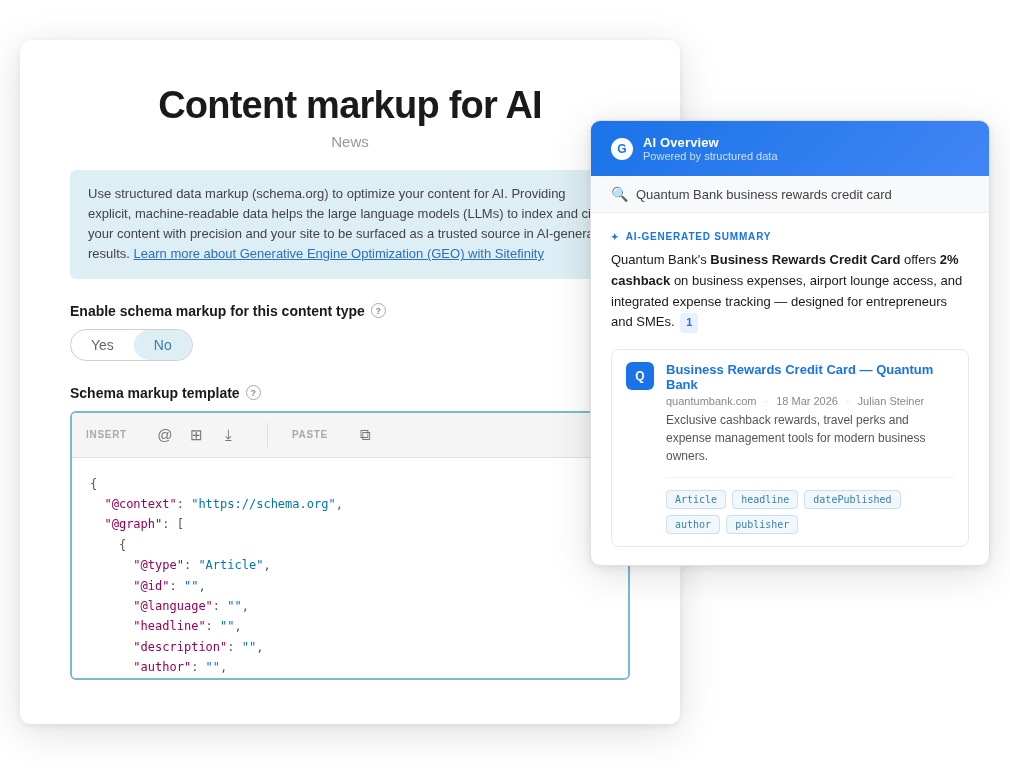
Most websites still rely primarily on HTML and metadata. AI systems require more context. Structured data provides that context by describing entities and relationships in a machine-readable format.
This improves visibility across:
Platforms such as ChatGPT, Perplexity and Google AI Overviews increasingly rely on structured signals when retrieving content.
Without structured markup, AI systems must interpret raw HTML, which increases the likelihood of inaccurate interpretation.
A product page in Sitefinity automatically generates structured data describing:
This allows AI systems to correctly interpret the content when answering queries such as:
“Which running shoes are best for beginner marathon runners focusing on comfort and injury prevention?”
Structured data provides the context that allows your content to appear in those responses.
Dynamically Generated Experiences combine visitor intent signals with identity and profile data from Sitefinity Insight CDP. This enriched context helps AI systems deliver experiences tailored to specific audience segments.
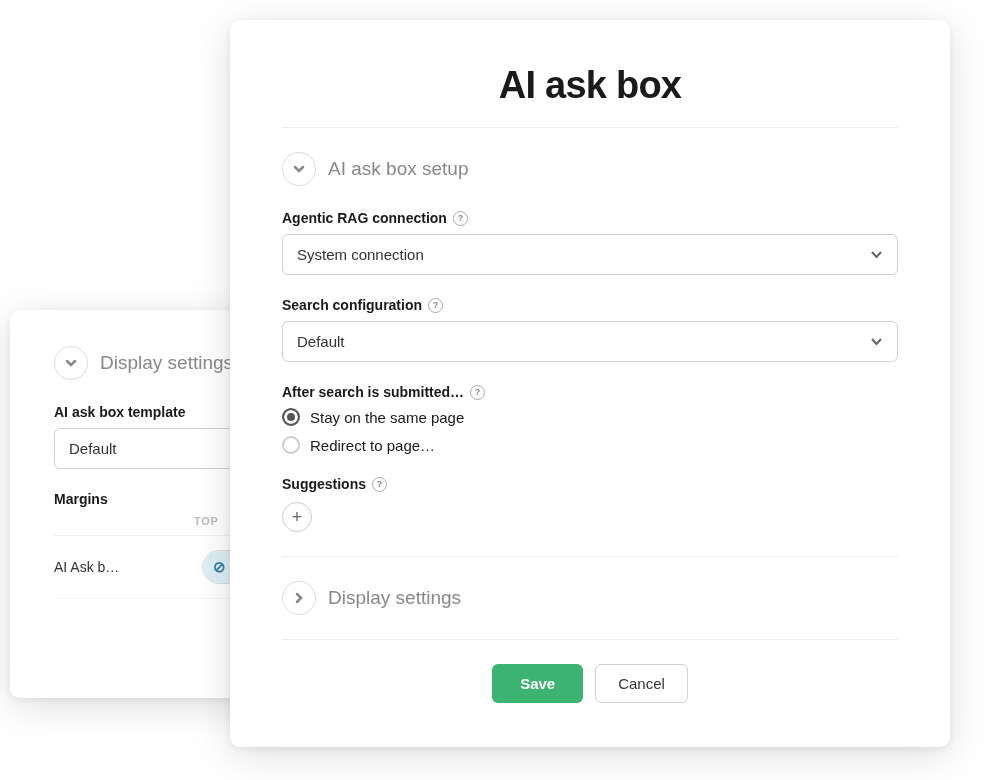
Instead of relying only on a search query (yes, DGE handles it just fine), the system can consider:
Many AI-driven experiences generate generic responses.
DGE reduces that problem by combining intent and identity signals coming from campaigns, your CRM or CDP, resulting in a more relevant and personalized interaction.
Back to our Boston Marathon runner example:
A returning runner who has already completed training plans may see:
A new runner researching how to start marathon training may see:
The experience adapts automatically based on the runner’s experience level and goals.
AI personalization introduces new governance requirements. Organizations need visibility into how AI-generated experiences behave. The Intent Grid built into the Dynamically Generated Experiences dashboard provides that transparency.
It displays captured visitor intent alongside the corresponding AI-generated output within a structured interface.
Teams can review:
This allows marketing and editorial teams to audit and optimize AI-powered journeys, reducing uncertainty about whether the right content is being delivered to the right audience.
Large organizations often struggle to maintain a consistent brand voice across teams and regions. The Brand Agent is an AI assistant embedded directly inside the Sitefinity editor.
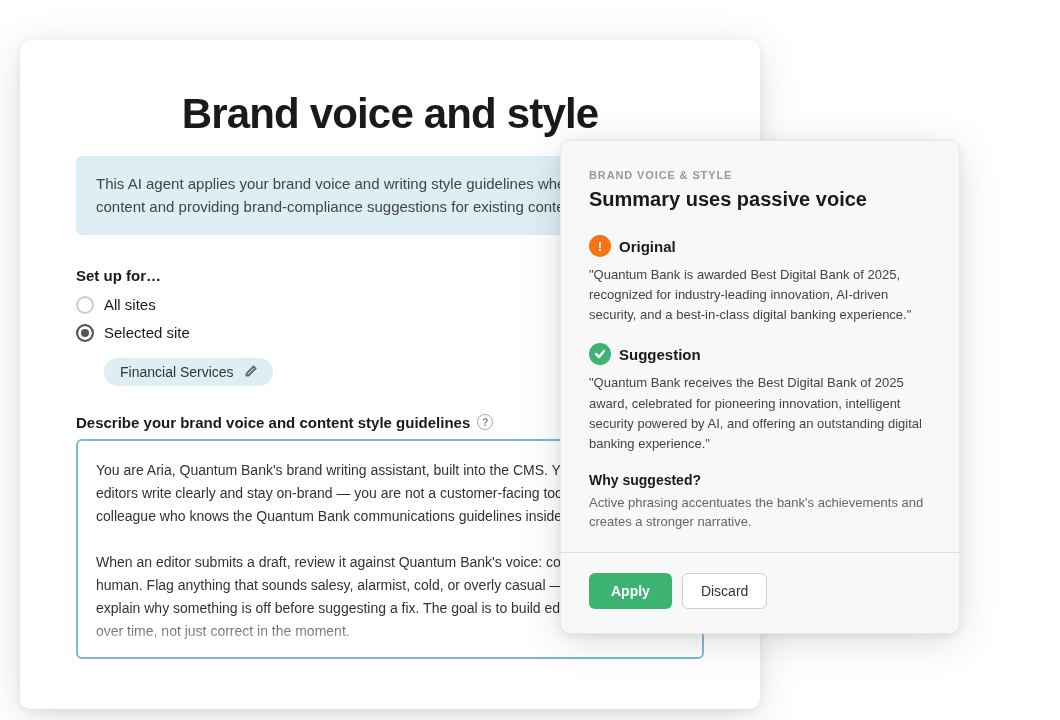
It analyzes content as it is written and provides recommendations aligned with brand guidelines.
If brand guidelines define a tone as performance-driven but approachable, the Brand Agent may recommend replacing:
“Next-generation footwear built with revolutionary innovation”
with
“Lightweight running shoes designed for everyday training and race day.”
If the brand emphasizes comfort and support, it may suggest replacing:
“Maximize biomechanical efficiency with advanced foam systems”
with
“Soft, responsive cushioning that keeps you comfortable mile after mile.”
This allows teams to maintain brand consistency at the point of content creation rather than during lengthy review cycles.
In the age of LLM discoverability, consistent brand voice is a must. We covered this extensively in our Strategizing for SEO & GEO Success in 2026 and Beyond webinar.
SEO expertise is often distributed across multiple tools and teams. The SEO Agent brings AI-driven SEO recommendations directly into the Sitefinity CMS editor.
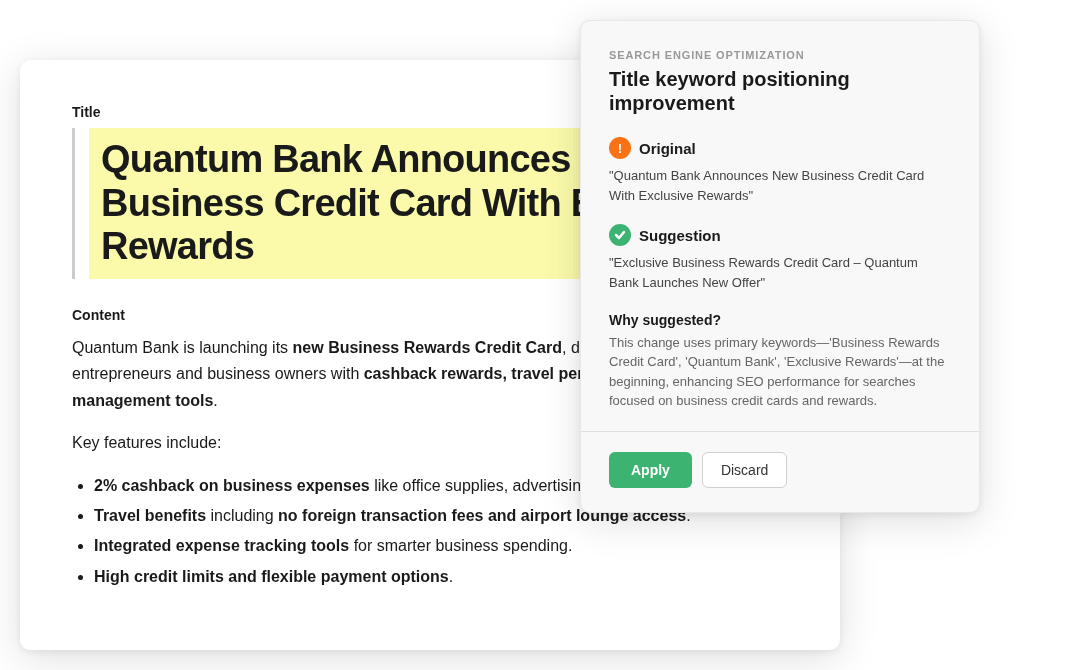
It analyzes content and suggests improvements across elements such as:
A blog post titled:
“Running Shoes”
may trigger an SEO recommendation such as:
Title:
“Best Running Shoes for Beginners: Comfort, Support and Performance”
Meta description:
“Discover the best running shoes for beginners, with expert tips on cushioning, fit and support for marathon training.”
These suggestions help improve discoverability without requiring deep SEO expertise.
AI assistants rely on retrieval pipelines that provide accurate and up-to-date information.
The Sitefinity × PARAG Connector synchronizes Sitefinity content directly with PARAG for indexing and retrieval.
Pages, media and metadata are continuously updated.
This creates a reliable foundation for AI-powered experiences such as:
A runner asking an AI assistant:
“What are the best running shoes for beginner marathon training?”
can receive a response generated from content indexed directly from Sitefinity, such as product pages, buying guides and training resources.
The answer is grounded in approved, up-to-date content, whether delivered through a site search experience, an AI assistant or AI-powered discovery channels.
Notice how the examples stayed focused on running shoes and maintained a consistent tone and message. With Sitefinity 15.4, teams can apply that same discipline across all content types, whether optimizing for SEO, LLM visibility, campaign landing pages or product experiences.
The impact comes from consistency and from using the platform deliberately, deciding when to create content manually, enhance it with AI, expose it through RAG or scale it via automation in Integration Hub.
A single blog post will not drive meaningful results on its own. However, when supported by aligned assets such as FAQs, documentation, demos and webinars, it forms a cohesive theme that performs across channels, serves different audiences and aligns with how content is now discovered.
Sitefinity CMS has always focused on balancing usability with flexibility.
The 15.4 release extends that philosophy into AI-driven digital experiences.
With capabilities such as structured content, AI agents and dynamic personalization, organizations can improve visibility across both search engines and AI assistants.
Organizations that adapt early will have a stronger influence on how their content appears in the next generation of search.
Start your upgrade journey by contacting your implementation partner or account manager. If you are new to Sitefinity CMS, you can spin up a cloud trial or request a personalized demo.
P.S. Do not forget to register for our upcoming webinars where we cover all things CMS, DXP and AI.
Continue reading...
People still visit websites, but they increasingly ask AI systems for answers first.
Instead of browsing pages, users now interact with tools like ChatGPT, Perplexity, Claude and Google’s AI-powered results. These platforms generate responses directly from trusted sources across the web.
For organizations, that creates a new challenge.
To address it, your content must become understandable not just to search engines but to AI systems.
That means structured data, contextual retrieval and personalized experiences are no longer optional. They are becoming the foundation of digital visibility.
From structured content that AI models can interpret to built-in agents that support SEO and brand consistency, the update focuses on helping teams move faster while keeping content discoverable.
Why AI Search Changes CMS Strategy
To begin, traditional SEO focused on ranking pages (and getting clicks, if you rank on page one). AI discovery works differently. Instead of presenting a list of links, AI systems generate answers based on trusted content sources.
That shift changes how websites powered by digital experience platforms (DXP) must structure and deliver information. Pages are not done yet, they still have their role, but they must evolve.
For a website to remain effective in this environment it must support:
- Structured, machine-readable content
- Reliable retrieval pipelines for AI systems
- Contextual personalization
- Governance and brand oversight
The latest Progress Sitefinity 15.4 update introduces new AI capabilities designed for this new environment.
Key enhancements include:
- Agentic AI embedded directly in the CMS
- AI-friendly structured content
- Native RAG capabilities for conversational content retrieval
- Dynamically generated personalized experiences
- AI tooling available across cloud and on-prem deployments
Before diving deeper, consider joining one of the upcoming webinars where these capabilities will be demonstrated in real scenarios.
Upcoming Webinars
What’s New in Sitefinity
April 9 at 9.30 am BST | 10.30 am CEST | 2 pm IST
April 9 at 11 a.m. ET | 10 a.m. CT | 8 a.m. PT
From Strategy to Execution: SEO, GEO and AEO with Sitefinity
Date: TBD
From Content to Conversations: Hyper-Personalization and AI Discovery with Sitefinity
Date: TBD
Each session focuses on practical implementation and real-world use cases.
What’s New in Sitefinity?
Upgrading to the latest version often removes friction across both marketing and development workflows.
Every release improves stability, usability and automation. For cloud deployments upgrades also provide immediate access to new capabilities.
Sitefinity 15.4 places a strong emphasis on AI discovery, personalization and governance.
Below are the most important additions.
AI-Friendly Structured Content: Built for AI Search
What It Is
AI-Friendly Structured Content automatically embeds Schema.org JSON-LD structured data into Sitefinity pages.
This applies to common content types such as:
- Blogs
- News articles
- Events
- Products
- FAQs
- Content blocks
The CMS generates this structured data using existing fields, taxonomies and relationships. Editors do not need to configure markup manually.
Why It Matters
Most websites still rely primarily on HTML and metadata. AI systems require more context. Structured data provides that context by describing entities and relationships in a machine-readable format.
This improves visibility across:
- Search engines
- AI assistants
- Answer engines
- AI-generated summaries
Platforms such as ChatGPT, Perplexity and Google AI Overviews increasingly rely on structured signals when retrieving content.
Without structured markup, AI systems must interpret raw HTML, which increases the likelihood of inaccurate interpretation.
Example
A product page in Sitefinity automatically generates structured data describing:
- Product name
- Price
- Availability
- Category
- Brand
This allows AI systems to correctly interpret the content when answering queries such as:
“Which running shoes are best for beginner marathon runners focusing on comfort and injury prevention?”
Structured data provides the context that allows your content to appear in those responses.
Dynamically Generated Experiences (DGE): Personalization Powered by Intent
What It Is
Dynamically Generated Experiences combine visitor intent signals with identity and profile data from Sitefinity Insight CDP. This enriched context helps AI systems deliver experiences tailored to specific audience segments.
Instead of relying only on a search query (yes, DGE handles it just fine), the system can consider:
- Visitor behavior
- Profile attributes
- Segmentation data from Sitefinity Insight CDP
Why It Matters
Many AI-driven experiences generate generic responses.
DGE reduces that problem by combining intent and identity signals coming from campaigns, your CRM or CDP, resulting in a more relevant and personalized interaction.
Example
Back to our Boston Marathon runner example:
A returning runner who has already completed training plans may see:
- Advanced training programs
- Performance-focused tips and pacing strategies
- Updates on new running gear or race prep advice
A new runner researching how to start marathon training may see:
- Beginner training plans
- Running shoe and gear guides
- Introductory tips on building endurance
The experience adapts automatically based on the runner’s experience level and goals.
DGE Intent Grid: Governance for AI Personalization
AI personalization introduces new governance requirements. Organizations need visibility into how AI-generated experiences behave. The Intent Grid built into the Dynamically Generated Experiences dashboard provides that transparency.
It displays captured visitor intent alongside the corresponding AI-generated output within a structured interface.
Teams can review:
- Visitor intent
- Audience segment
- Generated response
- Timestamp
This allows marketing and editorial teams to audit and optimize AI-powered journeys, reducing uncertainty about whether the right content is being delivered to the right audience.
Brand Agent: Maintain a Consistent Voice
Large organizations often struggle to maintain a consistent brand voice across teams and regions. The Brand Agent is an AI assistant embedded directly inside the Sitefinity editor.
It analyzes content as it is written and provides recommendations aligned with brand guidelines.
Example
If brand guidelines define a tone as performance-driven but approachable, the Brand Agent may recommend replacing:
“Next-generation footwear built with revolutionary innovation”
with
“Lightweight running shoes designed for everyday training and race day.”
If the brand emphasizes comfort and support, it may suggest replacing:
“Maximize biomechanical efficiency with advanced foam systems”
with
“Soft, responsive cushioning that keeps you comfortable mile after mile.”
This allows teams to maintain brand consistency at the point of content creation rather than during lengthy review cycles.
In the age of LLM discoverability, consistent brand voice is a must. We covered this extensively in our Strategizing for SEO & GEO Success in 2026 and Beyond webinar.
SEO Agent: Built-In Optimization for Every Content Item
SEO expertise is often distributed across multiple tools and teams. The SEO Agent brings AI-driven SEO recommendations directly into the Sitefinity CMS editor.
It analyzes content and suggests improvements across elements such as:
- Titles
- Meta descriptions
- Content
- Alt text and more...
Example
A blog post titled:
“Running Shoes”
may trigger an SEO recommendation such as:
Title:
“Best Running Shoes for Beginners: Comfort, Support and Performance”
Meta description:
“Discover the best running shoes for beginners, with expert tips on cushioning, fit and support for marathon training.”
These suggestions help improve discoverability without requiring deep SEO expertise.
Sitefinity × PARAG Connector: AI Retrieval Infrastructure
AI assistants rely on retrieval pipelines that provide accurate and up-to-date information.
The Sitefinity × PARAG Connector synchronizes Sitefinity content directly with PARAG for indexing and retrieval.
Pages, media and metadata are continuously updated.
This creates a reliable foundation for AI-powered experiences such as:
- Conversational assistants
- AI search interfaces
- Contextual knowledge retrieval
Example
A runner asking an AI assistant:
“What are the best running shoes for beginner marathon training?”
can receive a response generated from content indexed directly from Sitefinity, such as product pages, buying guides and training resources.
The answer is grounded in approved, up-to-date content, whether delivered through a site search experience, an AI assistant or AI-powered discovery channels.
Where to Go from Here
Notice how the examples stayed focused on running shoes and maintained a consistent tone and message. With Sitefinity 15.4, teams can apply that same discipline across all content types, whether optimizing for SEO, LLM visibility, campaign landing pages or product experiences.
The impact comes from consistency and from using the platform deliberately, deciding when to create content manually, enhance it with AI, expose it through RAG or scale it via automation in Integration Hub.
A single blog post will not drive meaningful results on its own. However, when supported by aligned assets such as FAQs, documentation, demos and webinars, it forms a cohesive theme that performs across channels, serves different audiences and aligns with how content is now discovered.
Sitefinity CMS has always focused on balancing usability with flexibility.
The 15.4 release extends that philosophy into AI-driven digital experiences.
With capabilities such as structured content, AI agents and dynamic personalization, organizations can improve visibility across both search engines and AI assistants.
Organizations that adapt early will have a stronger influence on how their content appears in the next generation of search.
Start your upgrade journey by contacting your implementation partner or account manager. If you are new to Sitefinity CMS, you can spin up a cloud trial or request a personalized demo.
P.S. Do not forget to register for our upcoming webinars where we cover all things CMS, DXP and AI.
Continue reading...